How do we recognize what could be?
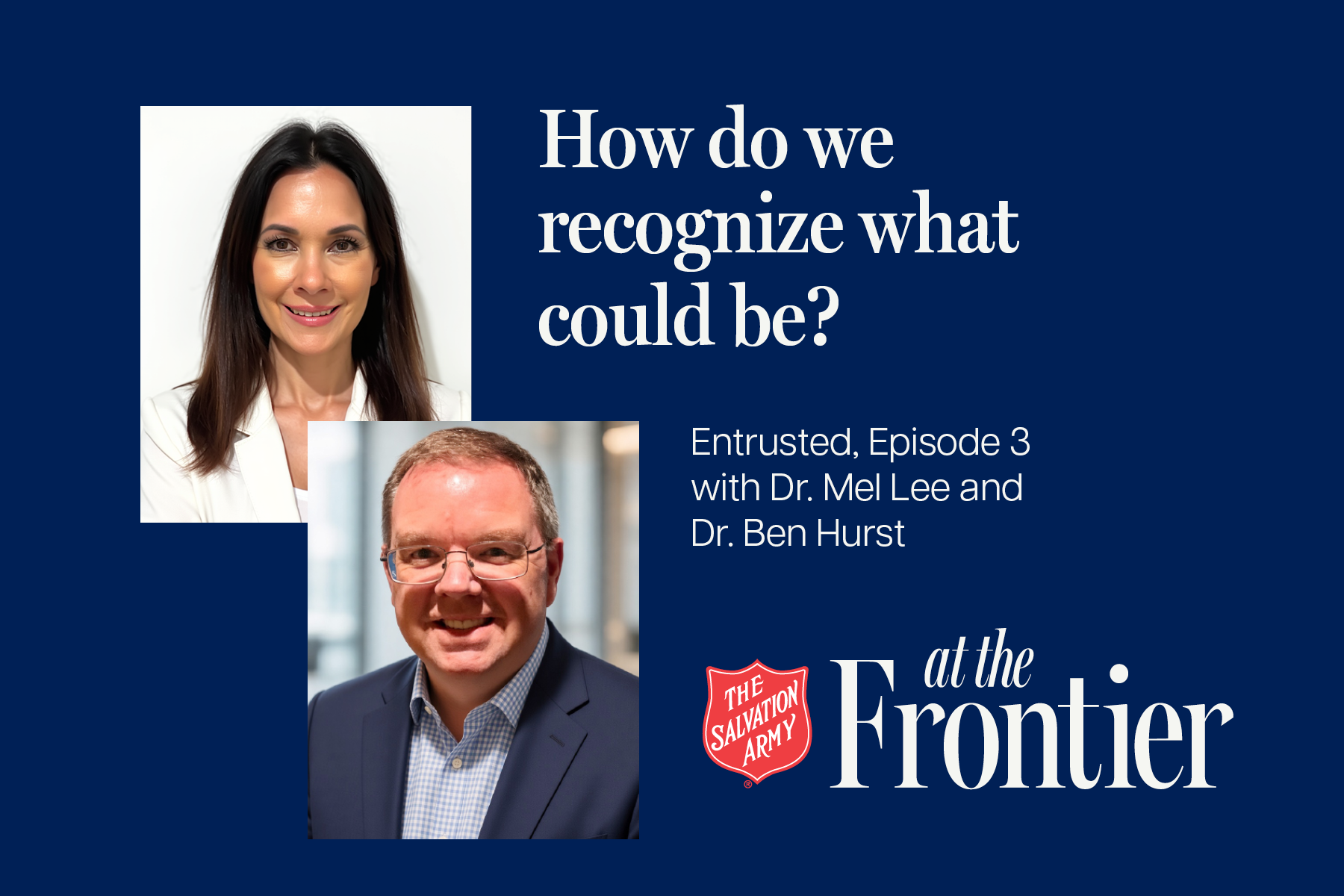
Entrusted, Episode 3 with Dr. Mel Lee and Dr. Ben Hurst
What if faithful stewardship means more than protecting what we've already been given? What if it also means recognizing possibilities we haven't yet imagined?
In the third episode of “Entrusted,” a six-part series from At the Frontier, host Christin Thieme speaks with Dr. Mel Lee, Director of Design Strategy and Research, and Dr. Ben Hurst, Managing Director of The Salvation Army's Center for Applied Research and Innovation (CARI).
Together, they explore how faith, listening and human-centered design can help The Salvation Army recognize emerging needs and develop new ways to respond. They share how an underused dirt lot in Anaheim, California, became the starting point for a comprehensive campus serving people experiencing homelessness, and why the people closest to a problem must help shape its solution.
The conversation also considers how to distinguish a meaningful opportunity from an interesting idea, experiment responsibly when people's lives are at stake and make room for imagination within an established organization.
In this episode
-
Why innovation begins with attention: How listening to people with lived experience, frontline staff and community partners can reveal needs that existing systems overlook.
-
From a dirt lot to the Center of Hope: How a homelessness crisis in Orange County prompted The Salvation Army to imagine a different use for its Anaheim property.
-
Deciding which ideas deserve attention: Why mission alignment, human dignity, evidence and spiritual discernment matter more than novelty.
-
Experimenting without putting people at unnecessary risk: How human-centered design, early feedback and small-scale prototypes help test assumptions before committing significant resources.
-
Stewarding what doesn't exist yet: Why imagination, humility and a willingness to reconsider established approaches are part of preparing for future needs.
Listen to the episode
Listen and follow At the Frontier wherever you get your podcasts.
Episode transcript
The following transcript has been edited for clarity and readability.
Christin Thieme: An opportunity appears…a need changes…a new idea emerges…someone sees a way of doing something differently. But how do we know which opportunities deserve our attention?
Because not every interesting idea is a meaningful opportunity—not every open door is ours to walk through. And sometimes the greater risk isn’t changing too quickly. It’s failing to notice the world around us has already changed.
So how do we recognize what the moment requires?
And if something has been entrusted to us, how do we know when faithfulness means protecting what already exists, and when it means imagining something new?
I'm Christin Thieme, and this is At the Frontier—a podcast from The Salvation Army Western Territory exploring the questions shaping faith and mission.
In this series, we’ve talked about what it means to care faithfully for the resources we already have. But what about the possibilities we haven’t recognized yet?
That’s where today’s guests spend much of their time.
Dr. Mel Lee is Director of Design Strategy and Research, and Dr. Ben Hurst is Managing Director of The Salvation Army's Center for Applied Research and Innovation, or CARI.
Together, they help the Army look differently at familiar problems, understand emerging needs and explore new ways to respond.
So I wanted to ask them: How do we know when an idea is worth pursuing? And how do we make room for imagination without losing sight of our responsibility to the people we’re trying to serve?
Dr. Lee and Dr. Hurst, thanks for being here.
Dr. Ben Hurst: Thank you.
Dr. Mel Lee: Thank you.
Dr. Ben Hurst: The pleasure is ours, Christin. Appreciate the invitation.
Christin Thieme: Absolutely. I know both of you spend a lot of time thinking about how things could work differently. So I'm wondering when you encounter a problem or a need, how do you recognize the current way of doing things may no longer be enough?
Dr. Ben Hurst: That's a great question. I think I'll set the stage and really ask Dr. Lee to help flesh these ideas out a little bit. At CARI, we talk a lot about recognizing God is the prime mover, the initiator of new ideas, of innovation. That's an important theological concept within The Salvation Army movement.
One thing I would touch on for a minute is John Wesley used to talk about the term "responsible grace" and he would speak about God's Spirit empowering people to salvation, to life transformation, and in our space, in social innovation and service, that there's an empowering grace of God's Spirit at work and that our responsibility is to "respond" to that grace, thereby his term, "responsible grace." So in the CARI context, one of the things we do is we are searching for the kinetic energy of the Spirit. We are trying to discern what God is doing.
Jesus said himself, "I only do what I see my Father doing." And I think unpacking that theologically, that is a recognition that God's Spirit is alive and active and is trying to reconcile the world unto himself and trying to heal, deliver, restore, set free. These are all foundational themes in our Christian mission social work efforts. So we're trying to discover and align ourselves with the activity God's Spirit is already doing.
And our best success is when we get that alignment and that just becomes a continual adventure and an exciting quest to see what God is initiating in our own community and more widespread in our nation and across the world for global leadership, so to speak. So that's where it begins. And I think that's the critical theological foundation. And then on top of that, we unpack some tremendous innovation tools that I hope my great friend Dr. Mel will speak about some.
Christin Thieme: Before we get into those tools, can you give us a little context for anybody listening who might not be familiar with CARI? What is it? What are you doing? And so on.
Dr. Ben Hurst: Oh, absolutely. Absolutely. CARI is one of, if not the first in the world Salvation Army, social innovation research and development center, a dedicated space for that. Of course, there's innovation happening all the time worldwide across The Salvation Army. We know and applaud that, but this is a dedicated space where we've carved out staffing and facility space to think deeply about issues and really try and find the signal through the noise. That's a big deal. There's a lot of distracted white noise out there operationally that keeps our best leadership from having the time, really.
That's a fair way to put it because that's a lot of what it is, having the time to get that balcony space to really think and explore innovative new responses to some of our boldest challenges. So we've put CARI, that's the acronym for the Center for Applied Research and Innovation, CARI.
We've put it right in the middle of a 14-acre comprehensive care campus called the Center of Hope in Anaheim, California, where we've got a 325-bed low-barrier emergency shelter. We've got 70 units of permanent supportive homeless housing.
And then we've got a fantastic 175-bed Adult Rehabilitation Center, an ARC right here on campus. And collectively, we're providing almost 600 beds of care and service to the Orange County and Southern California community. So CARI is kind of the innovation engine, parked right in the middle of that and driving our future thoughts and initiatives in that space. And please add any of that you want, Dr. Mel.
Dr. Mel Lee: Yeah, thank you. I actually, I love all of this. I want to go back to the original question that you asked, which was how do we know...And I don't know if you want to ask it again, Christin, but it was something along like, how do we know if the problem that we are solving is the right one? How do we know what to pay attention to? Was that in the neighborhood of the question you were asking?
Christin Thieme: Yeah, exactly. And how you recognize the current way of doing things might not be enough for the moment.
Dr. Mel Lee: Perfect. So Ben talked a lot about this piece of faith and being guided by the Holy Spirit and sort of a spiritual dimension to what is traditionally known as an innovation human-centered design space of understanding possibility. And I think as leaders, a part of our responsibility is not just caring for what exists, but really paying attention to what could exist. And I think that's really at the heart of what we are trying to build at CARI at the Center for Applied Research and Innovation.
And to just speak into that a little bit more, innovation to me, and I think to Ben, isn't about chasing the newest technology or even the newest idea. It's really about leaning into empathy and listening, being more attentive to the world around us and asking questions, like, "What is changing? What are people experiencing? What are we learning? And how might we begin to think about these things in a different way? And how are people and these problems we're addressing inviting us to do things differently?"
So I really think of innovation as the stewards of the not yet. And I think Ben has brilliantly helped me to think about that through his vision of the Center of Hope and the work that we're doing. And I'll just pause there, see if you want to add to that, Ben.
Dr. Ben Hurst: No. I love that. I was thinking this morning on my drive into the CARI site, I'm in the construction trailer at the CARI construction site for our viewers. We'll have our CARI facility completed in about 12 months, two miles from Disneyland. So come, visit. But enough of that. I was thinking on the drive in. I think one of the reasons this works so beautifully is human-centered design tries to unpack what is within the individual with extraordinary tools, unlocking the insight within.
That aligns with a vision of responding to God's Spirit because we've got Christ in us. We've got the inviting presence of God's Spirit within us. So that is the place you would fundamentally theologically look. You don't look outside, you look together collectively, intuitively, investigatively within. And Christ said, "Two or more gathered in my name. I'm in the midst of you." So there's some kinetic spiritual energy around the group activities of ferreting out direction, design, new ideas and innovation as a working group. I think it actually works incredibly beautifully to see. Yeah.
Christin Thieme: So as people who are focused on innovation, would you say that innovation begins with paying attention to a problem? And if so, who gets to define what the actual problem is? Where does it begin?
Dr. Mel Lee: That's exactly right. Innovation begins with attention. Before we ask what should we create, we ask what are we being invited to notice? And that means listening deeply to people. And so a big part of the first part of innovation and what we call human-centered design is empathy. So listening to people in our...Let's just talk about it in terms of addressing the wicked problem and tractable issue of homelessness and housing insecurity.
It means listening to people who've experienced that, lived experience. It means listening to frontline staff who encounter our systems every day. It means looking at the data and observing experiences of people. It means looking at and paying attention to workarounds and where people are frustrated in our current homelessness response system in Orange County.
And it's looking for moments when someone's dignity is unintentionally compromised, where they are experiencing a pain point and seeing the problem through a very different lens than maybe those of us who are administering the system or designing it are seeing. And we have to stop and talk with people and lean into what their experience is as reality rather than designing from the outside and kind of being in a bubble. So I'll stop there and see if Ben wants to add to that or if you have any questions.
Dr. Ben Hurst: No, I have a deep appreciation for the commitment to listening to lived experience expertise. And then we couple that with community leadership engagement because obviously God works through appointed officials and elected leadership in communities as well. So in dialoguing with them, they know their communities, they know where they're hurting, they know where some of the toughest trouble spots are, et cetera. It's through that double engagement up in all directions, I should say, that you get a sense of where need is urgent and present.
Dr. Mel Lee: Right. And I would say that adding to that, I think the people that are closest to the problem are closest to the solution. And that's both from the, let's say kind of a larger-scale organizational point of view. They might see a part of the problem that they want to solve for, and then the people that are experiencing it on the ground, they might see a different problem that we have to solve for, but you have to take into account all of the views.
So we always start with stakeholder mapping, trying to understand who are the people that are touching this problem, and then focusing in on what can get done. We don't try to boil the ocean. Homelessness is a really big problem to solve. So we look at it and break it out into chunks and think about specifically what is the problem that we want to focus our attention on for the next three months.
And we just drill down into that and use a process called human-centered design where we co-design with the people who are experiencing the problem. And it's a very exciting process and it's one that we are going to be engaging in, have been engaged in the past couple months by re-imagining our anti-trafficking services in our Anaheim Emergency Shelter, working with universities like Concordia and the Hive Claremont Colleges to look at how might we reduce unsheltered street homelessness.
And it's a process that we're going to be using as we investigate how we might create a really bold drug mitigation program really around treatment and recovery that might include animal-assisted therapy. So it's super exciting. I love how we're leaning into really difficult problems and we're being really bold about it.
Christin Thieme: That's an interesting point you bring up, and I'm wondering if you can say more about that because I think when we're looking at these very complex problems, it's easy to have a lot of ideas, especially in big organizations where we have a lot of people working towards solutions. So how do you distinguish between an opportunity that is worth pursuing and something that might be more of a distraction that happens to be exciting?
Dr. Mel Lee: Yes. Well, once you start paying attention, you start to see opportunities everywhere. And for me, it's kind of hard to focus in. One of the things that I learned when I was at Stanford d.school is to really simplify. Not every interesting idea is a meaningful opportunity. And I think one of the hardest parts of innovation isn't actually generating the ideas, it's deciding which ideas deserve our attention. And that's where discernment, and I'll lean in to this for a moment and then ask Ben to speak more about it, but I think discernment becomes incredibly important.
At CARI, some of the questions that we are learning to ask is this problem rooted in a real human need? Does it advance dignity? Does it align with our mission? What evidence do we have? What don't we know yet? And where are areas that we can test our assumptions responsibly?
And perhaps most importantly, are the people who will be affected by us solving this problem, will they be helping us shape it? So I just want to lean on that discernment piece, and I think that's such a special word in the context of spiritual discernment as well that I think we're trying to unpack in terms of really designing a new way of doing human-centered design that's leaning on faith-based design. So I'm going to pause there because I know Ben's super excited about this and see if he'd like to lean into that a little bit more with us.
Dr. Ben Hurst: Yeah, I would. Thank you. I love...I'm energized by what you're saying. I personally go back again building on this to the kinetic spiritual energy concept that ... You're talking about how do you decide what ideas are worth actually pursuing to try and realize or activate? I think some of that is, as Dr. Mel said, you're using spiritual discernment to look for the kinetic energy of God's Spirit at work in an idea, literally in an idea.
And one of the ways you come to understand it is it's got an energy behind it. When you share it with community stakeholders, when you share it with lived experience experts, we've got this idea we're thinking about, what do you think about this? And there's an aha moment. You're looking for ideas that have a sense that that really must be done. If it's possible to do it, that must be done.
It's got that kind of excitement energy behind it. And that's at a macro level. Not everything you're doing is going to have that electricity to it. But in general, as Spirit-filled, Spirit-led people, I think that's kind of how the process practically unfolds, really. And I would tell Christian leaders that very exact thing.
Dr. Mel Lee: And Ben, I know I'm putting you on the spot now, but I love when you tell the story about being on the lot, this empty lot at the center of hope and how Spirit spoke to you about what could be. Can you tell a little bit about that? Because I think there's a meaningful thread here that we can pull on.
Dr. Ben Hurst: Yeah, for sure. We had 3,000 people living in a homeless camp along the Santa Ana River in 2018, and The Salvation Army had a 14-acre property where the south seven and a half acres were a dirt lot being used for truck storage. So we stood on that dirt lot and tried to imagine a bold response to a homeless emergency.
Our community declared a state of emergency, and we wanted to run towards that fight with faith. So we were asking ourselves, "What's the boldest we could imagine a reach for in faith in the eyes of the Spirit?" And collectively came up with a 600-bed homeless care campus that included the great work at our friends at the ARC on the site and really leaned into that. And what we discovered when we shared that idea, it had energy behind it. And that was one of the first questions Salvation Army leadership had for us was, we know you think you're onto something.
We respect what you're saying, but is your community behind this? They said, go back and talk to community leaders and report back to us that they will get behind this idea. And it's in that dialogue and exchange that we recognize the wind of the Spirit's on this thing. And as a subsequent result, we were able to build a 224-bed, trauma-informed emergency shelter in 79 days, really caught lightning in a bottle. And I attribute that wind of the Spirit we're talking about as the driver there. I think that's what you're talking about, Dr. Mel, but if not-
Dr. Mel Lee: That's it. That is the one.
Christin Thieme: That scene paints an interesting picture too, because I think innovation by nature has a layer of uncertainty. You don't necessarily know that something is going to work even though it's a good idea, right. So how do you move forward when you don't yet know something is going to work? We hear a lot in the Silicon Valley context about failing fast, but it's different when you're talking about real people's lives. So how do you experiment responsibly when the stakes involve real people?
Dr. Mel Lee: Right. No, that's such a great question. And I think that was when I mentioned how can we test this responsibly, that's one of the most important things we ask. So Silicon Valley operates by ... There's sort of a formula called the cost of an error. And a lot of times what happens is, and this was really true, I would say more in the business world than design world, is you'd get an idea, you put together a project plan, you have all your milestones and your timeline, and then you just go head down and you grind it out till you get to the end and then you implement it.
And then sometimes you find that your original business assumptions were incorrect or didn't really meet the need that you thought it met, or there might be unintended consequences. And Silicon Valley, I think, found over time that the cost of an error is that you've spent so much time invested in growing an idea, throwing resources at it to only find out down the line it didn't work, that's really the cost of an error.
And that's why there's this new mantra around failing forward and failing fast. And that is don't wait till something's fully built to get the idea in the hands of your end users or the people who would eventually be using a program or service, but sketch it out. Have a way of doing human-centered design, which is understand the problem you're trying to solve, who you're trying to solve it for, coming up with a lot of ideas for how to solve it with them, prototyping it in a very low-fidelity way, like, it could be a sketch or a back-of-the-napkin drawing that you then put into their hands and you get feedback on. So before you build anything, put too many resources into one idea or too much time invested in one solution, get feedback early and often and you iterate and you generally want to test the riskiest assumptions first.
And there are ways to do that through scenarios. I have done that in my work when I was at HUD and I worked with Ben at CARI for redesigning HUD state-webpages. We built scenarios that we then asked people to view as a vignette. And rather than asking a person experiencing homelessness to walk through how they would do a particular task or how they would address the scenario, we asked them to help a friend. So we took sort of away that kind of trauma of them having to focus on their own story and really if you could help someone else, how would you do it in this scenario? And we tested assumptions that way. So that's one short example. I don't know if that gets to what you were asking exactly or if Ben would like to expound on it.
Dr. Ben Hurst: Well, I think I would just say that's absolutely right in what you're talking about. And that's what I really appreciate about The Salvation Army leadership that has commissioned a program like CARI, because historically it's been difficult in the field to test ideas because generally speaking, leadership likes fully proven and vetted concepts to be submitted for approval. Well, how do you get from A to Z?
I think they recognize that issue too when they allowed us to create a space that professionally investigates and lo-fi prototypes and reports back and explores innovatively what might be, what could be. I think that's one of the great purposes of the CARI space and how it can be a resource to the larger Salvation Army organization. Yeah.
Christin Thieme: Maybe you can say a little bit more about that because I know generally speaking across large government systems, across academic settings, across nonprofits, there's often a critique that such established organizations have a hard time recognizing when the world around them is changing and being willing to sort of change what needs to be changed along the way. So how do you see CARI fitting into that? I mean, it seems like the opposite is true in this case, so maybe you can talk a little bit more about the value that's being put into innovation in our context.
Dr. Ben Hurst: Yeah, I would build on, I think, what I was saying. The Salvation Army has such an extraordinary history, and I'm out engaging in community leadership all the time, sharing that history. I was just speaking to a group of leaders last night, talking to them about our organization starting in 1865 and having our flag taken to the moon and back in over 132 countries and 7,400 service unit sites in the United States. It's an extraordinary story. But in the midst of that, a lot of our work is humanitarian compassion reaction work reacting to crises. I say that lovingly.
When we built the 224-bed shelter in 2018, opened it in 2019, it was a response. It was a reactive response to a humanitarian disaster. So I have a love and appreciation for that aspect, but it's difficult to create the space to thank a futurist and to try and imagine where the need is moving and where the solutions might be coming from and engage in that kind of work in a way that can give leadership some great data, some good concepts to consider, and hold those loosely.
At CARI, we realize not everything we explore will result in an approved scaled program. We absolutely know and understand that. That's one of the reasons we've got the space to investigate. So we hold concepts loosely knowing that that final decision is in the hands of leadership, of course, and divisional and territorial program review councils, et cetera. So yeah, there's a working symbiotic relationship there where they've empowered us to take the space to imagine in fidelity to the Christian mission of the organization and report robustly our findings so that big decisions can be made. I think that's where my mind goes, but how about you, Dr. Mel?
Dr. Mel Lee: I go there as well. I'm going to attach myself to one of the words you just said, which is imagination. And I love that the language in the context of innovation encompasses imagination as an important leadership capacity and an important leadership quality. When you talk about us changing systems, that can be really painful.
Systems don't like to change. Processes don't like to change, right. There's this idea of homeostasis and equilibrium. So we have to have a lot of humility around what we propose, and we have to really think about partnership and not just partnership with the people we're designing for and the cities and communities, but partnership with our internal staff, our internal leadership. It is really us working together to bring faith and human-centered design together in a really beautiful way that transforms lives.
I think that it's that partnership that we're grateful for, and I am especially grateful that leadership has given us this wide open field, a blank canvas, if you will, to really test out prototyping as a discipline, as an innovation as a discipline that could help us do the most good.
So I think as long as we always make sure that we're really aligned with mission and mission impact, I think I'm just very grateful that leadership's been so open to trying out new things and that they're willing to lean in with us into the learning, knowing that we're not going to have all the answers right away, and that's why experimentation and pilots are going to be really important in testing out what works and what doesn't work and developing communities of practice where we can lean on each other and share our learning across the organization. And I think that's something that I and Ben are very excited about.
Christin Thieme: When it comes to imagining the future, and you mentioned a few minutes back a couple of the projects that are going on right now, is there something in particular you could share a little bit about that you're excited about in looking at what comes next?
Dr. Mel Lee: Ben, do you want to talk about...You can pick anything, and then if you want to talk about LTP? Or...
Dr. Ben Hurst: Yeah, I would...I'll touch on that. Homeless substance use is an extraordinary issue, and we see it in real time at our now 325 bed low-barrier shelter. And certainly ARC is a great partner in a pathway out of that, but there is a gap of service there and they know that we talk robustly about it. You have to go through a detox component before you're even eligible for the ARC program, at least presently.
So bridging that gap with some sort of social detox is something, and a medical recovery, residential recovery component that could be a bridge to our more robust ARC work there Therapy program is something we're very interested in and are exploring. And we're asking unusual questions about, "Could we incorporate animal-assisted therapy into that?" We believe there's something there, but it's early days. There's no data on that yet. And we'll see where that goes, but it's very exciting.
Christin Thieme: I want to bring it back to a word you used earlier, discernment. For someone who senses that something around them needs to change, maybe it's a ministry program, a way of serving, whatever it is, but they don't yet know what the answer is. What's the first thing that you would tell them to do?
Dr. Ben Hurst: Go ahead, Dr. Mel.
Dr. Mel Lee: The first thing that I would ask them to do is to think about what would change if the "what if..." First of all, it's to think about the "what is" and try to define what the problem is that they're trying to solve for and think about who would be most impacted by that. And then go out and talk to those people. Human-centered design and change, imagination, innovation, all are encompassed in this concept of deep humility and knowing that we don't abide by genius theory or, "I'm the smartest person in the room," or, "'Cause I had so much experience or innovation and design that I have all the answers."
And I think the same is true for someone in ministry or someone who has been entrenched in a problem for a long period of time. To start out with humility, understanding that they may have a certain lived experience and a perspective on that problem. And it's so important to get out of that bubble and to understand the problem from different points of view and to invite people in. So that would be the first thing. I don't know if I answered your question or if I went off on my own delightful tangent.
Christin Thieme: No, no. As innovation experts, do you think recognizing what's been entrusted to us includes recognizing possibilities that don't exist yet?
Dr. Mel Lee: Yes. I think when we think about this idea of stewardship, we often think about taking good care of what we already have, protecting resources, sustaining programs, being responsible for what's placed in our hands. But when we look at design and we go from the "what is" to the "what if," there's a whole other dimension of stewardship.
And that is that we're entrusted with this idea of possibility. And I think that that's partly why I wanted Ben to tell that story of 3,000 people in the riverbank and then him standing on this dirt lot where there's nothing there. And now you see this beautiful campus at the Center of Hope cropping up incrementally with very different pieces developing and becoming their own thing.
Part of the responsibility that Ben took on when he saw this vision wasn't just looking at a dirt lot. It was taking on the possibility of what could exist and the "what if" and what would be built on that lot. And I think we're still building. And that's the truly exciting thing is here we are, how many years later, Ben? And we're still asking these questions from-
Dr. Ben Hurst: Yeah, about eight years later. Yeah.
Dr. Mel Lee: About eight years later, we're still asking questions.
Christin Thieme: Yeah, doesn't end. Well, I am ending every conversation in this series with the same question, so I'd like to pose it to both of you. Dr. Mel, why don't we start with you? What has God entrusted to you right now?
Dr. Mel Lee: God has entrusted in me this beautiful place, this blank canvas of becoming. And I think that the more I design and especially focused on social impact problems, the more I realize God's ... It almost makes me cry that he's working on me and he's redesigning me. And so I love that. So I lean into that place of spirituality, that place of having impact in the world with really deep humility.
And I'm just so excited about the partnership that he's led me to, the chance that I got to leap from 20 years of federal government experience to be in this very new place called The Salvation Army. It's new to me. And to be able to, as a thought leader, build through partnership and collaboration and sweat equity, this amazing new iteration of CARI with Ben and the team, leadership, frontline staff, people with lived experience, funders, and this beautiful community that's going to help address this problem of homelessness in Orange County.
Christin Thieme: And Dr. Ben, what has God entrusted to you right now?
Dr. Ben Hurst: Wow, what an extraordinary question to end on. Thank you for it. And thank you for those words, Dr. Mel. That was inspiring to me. Certainly the spiritual development of the Center of Hope, CARI program and some of our initiatives and the team that Dr. Mel and I are raising up in that space is front and center in a professional way. On a spiritual plane, since you asked what God is entrusting me at this moment, I think he has asked and invited me to be a voice for the marginalized.
I'm an ordained minister ordained in 1997 and at my ordination service, the elders of the church said, "You'll be a voice and not an echo, here to tell us what time it is." And I see that out and about in the community. I take that spiritual responsibility very seriously. And to the degree I do that, God does special things. So yeah, I think he's entrusted some of that to me. Thank you.
This episode is part of the “Entrusted” series from At the Frontier. Explore all six episodes examining what it means to faithfully care for what God has entrusted to us. Listen to the series.
Links and resources
-
Center for Applied Research and Innovation (CARI): Learn more about The Salvation Army's work to research emerging needs and explore new approaches to social services.
-
Part of the “Entrusted” series: Explore all six episodes examining what it means to faithfully care for what God has entrusted to us. Listen to the series.
-
From The New Frontier: Explore the “Entrusted” issue, featuring stories, ideas and perspectives on what it means to faithfully care for what God has placed in our hands.
Keep exploring
STAY CONNECTED. Subscribe to The New Frontier email newsletter for stories, ideas and conversations shaping The Salvation Army's mission.
FOLLOW ALONG. Find The New Frontier on Instagram for more from the people and communities we cover.
SUPPORT THE MISSION. Give to The Salvation Army.