If it’s God’s money, how do we decide what to do with it?
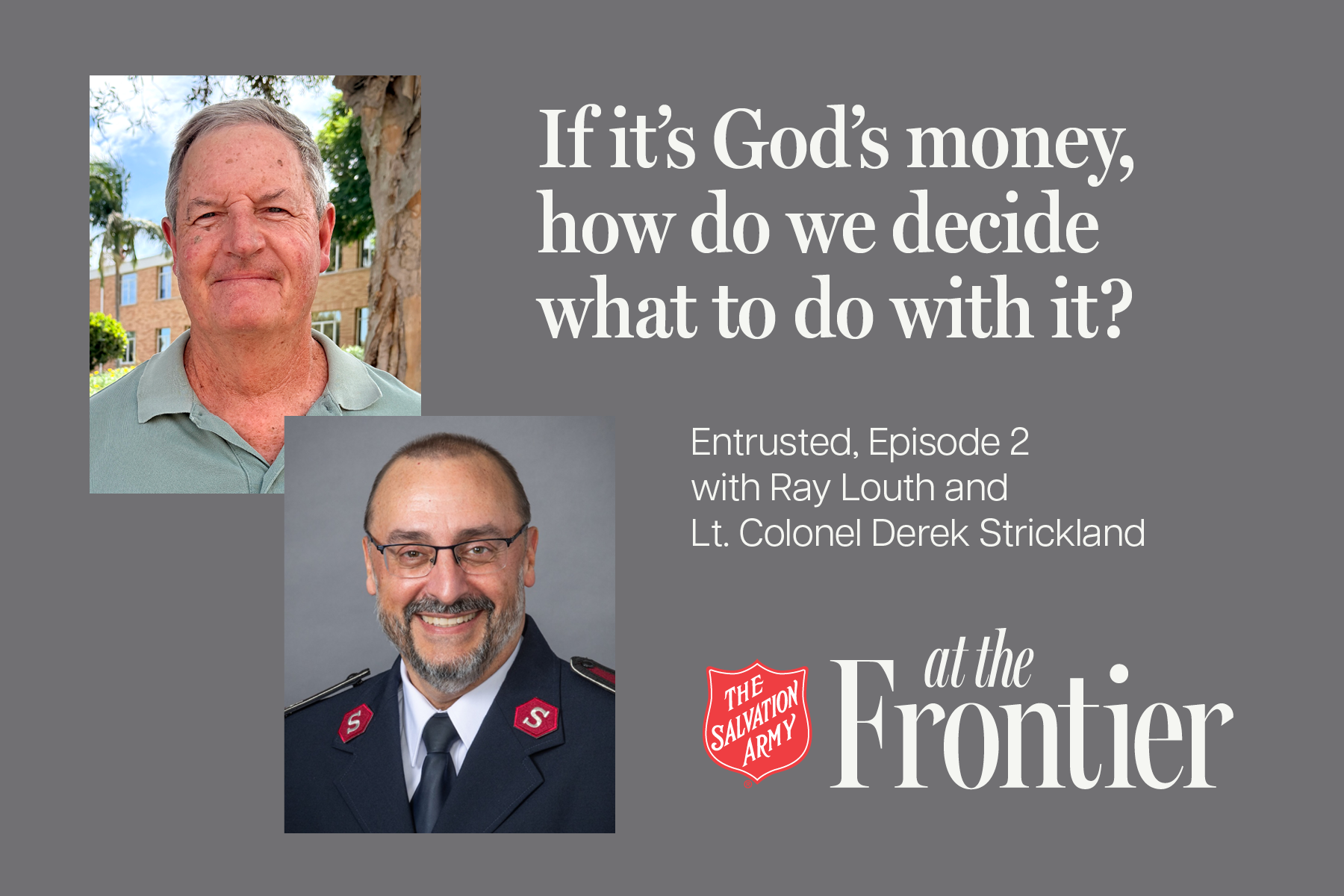
Entrusted, Episode 2 with Ray Louth and Lt. Colonel Derek Strickland
Spend or save? Give or hold? Protect what we have or put it to work?
If everything ultimately belongs to God, financial stewardship requires more than careful budgeting. It asks us to consider what our resources are for, whom they are meant to serve and how today's decisions will affect tomorrow.
In the second episode of “Entrusted,” a six-part series from At the Frontier, host Christin Thieme speaks with Ray Louth, who teaches biblical financial principles in Salvation Army Adult Rehabilitation Centers, and Lt. Colonel Derek Strickland, Territorial Secretary for Business Administration for The Salvation Army Western Territory.
One approaches these questions through personal finances; the other through the resources of a large organization. Together, they explore what it means to manage money faithfully, why generosity and financial responsibility aren't necessarily competing priorities, and how to recognize when caution becomes an obstacle to the mission.
From household budgets to a $20 red kettle donation, the conversation considers a difficult balance: How do we meet today's needs while preparing to serve tomorrow?
In this episode
-
What changes when we see money as entrusted rather than owned: How that understanding shapes everyday financial decisions and organizational accountability.
-
The tension between spending and saving: Why neither using everything now nor holding everything for later is necessarily faithful stewardship.
-
What comes with a $20 donation: Why The Salvation Army receives more than money when someone gives.
-
When risk is the responsible choice: How to discern whether to invest in something new, continue an existing program or recognize that its season has ended.
-
Making decisions with limited resources: Why faithfulness isn't measured by the size of a budget, and how wise counsel, contentment and mission alignment can guide our choices.
Listen to the episode
Listen and follow At the Frontier wherever you get your podcasts.
Episode transcript
The following transcript has been edited for clarity and readability.
Christin Thieme: Eventually, stewardship requires a decision.
Spend or save? Give or hold? Protect what we have—or put it to work?
Sometimes the responsible choice seems obvious. Often, it isn’t.
Because faithfulness isn’t simply about spending less. And it isn’t necessarily about preserving as much as we can.
So if the resources in our hands aren’t ultimately ours, how do we decide what they’re for?
And how do we know when the faithful choice is to hold on—and when it’s time to put something to work?
I'm Christin Thieme, and this is At the Frontier—a podcast from The Salvation Army Western Territory exploring the questions shaping faith and mission.
Throughout this “Entrusted” series, I’m asking what it means to faithfully care for what God has placed in our hands.
In our first conversation, New Testament scholar Dr. Craig Blomberg helped establish a starting point: A steward has responsibility for something that ultimately belongs to someone else.
And he complicated something for me.
I had started this series wanting to expand stewardship beyond money. But Scripture wouldn’t let us leave money behind.
So today, we’re making the idea concrete.
Ray Louth has spent years helping people think biblically and practically about their personal finances. He’s worked in banking, insurance and real estate, and has brought that experience into teaching biblical financial literacy at Salvation Army Adult Rehabilitation Centers across the West.
Lt. Colonel Derek Strickland serves as Territorial Secretary for Business Administration for The Salvation Army in the western United States, following years of work in organizational finance, including six years as an international auditor.
One works largely at the level of a household budget. The other helps oversee the resources of the Army.
But the fundamental question is the same: If the resources in our hands aren’t ultimately ours, how do we decide what to do with them? And what happens when two responsible choices seem to pull us in opposite directions?
Christin Thieme: Colonel, Ray, thanks for being here.
Ray Louth: You're welcome.
Lt. Colonel Derek Strickland: Great to be here.
Christin Thieme: When each of you hears the word stewardship, what does it mean to you? And does that meaning change when we're talking about $100 in someone's checking account, versus $1 million entrusted to an organization? Ray, let's start with you.
Ray Louth: Yeah. Stewardship is just another name for a manager. And for me the foundation is, we need to understand that God owns everything. Every single penny that's out there, God owns it. It says in Haggai 2:8, "The silver is mine and the gold is mine, declares the Lord Almighty."
And we are also required to be good stewards of that. It says in 1 Corinthians 4:2, "Now it is required that those who have been given a trust must prove faithful." So, it's all God's money, he lets us use it, but he has rules for us to follow. So yeah, that's how I see stewardship. We're required to be good managers.
Lt. Colonel Derek Strickland: Yeah, absolutely. And on an organizational level, when you add one or three zeros to the numbers, it's the same concept. Obviously, God has entrusted The Salvation Army with these amazing resources, and we need to approach it in the same way. He's entrusted it to us.
So there's a lot of trust surrounding that, not just with us, with the donors, with someone who's giving us $100, someone giving us $10 million, but we need to be very mindful of that. And as faithful followers of Jesus, to be very sincere in how we approach that and have it be part of our DNA, and not just be a lip service or something in a policy, but actually live and breathe what that means, because it brings about some discernment, some accountability. And it's a big conversation, and thankfully it's been with us since our very beginnings as an organization. William Booth was very big on accountability back then, and that thankfully has continued across the 160 years.
Christin Thieme: So, if I genuinely believe resources are entrusted to me rather than simply mine, what actually changes?
Lt. Colonel Derek Strickland: There's somebody else in the room watching you, right? And then we would say it's the Lord, the Holy Spirit speaking into it. And hopefully, that's how we see that across the organization.
So yes, there's money coming in. Yes, there's a lot of exciting things happening, but God has entrusted us with this resource, in this time, in this way, in this mission that we're doing. And we've got to be mindful of that, because if we misuse it, then that trust can very quickly disappear. And we need to be ever conscious of that because it's not just us now, it's the future generations and the future Salvation Army that'll be looking to that.
Thankful to the decisions that were made again now in 2026, back in 1965, back in 1865. Right? We want to continue with that in that faithful reliance upon God that he is absolutely going to fund us and provide us what we need to do the mission here in the USA.
Christin Thieme: When a financial decision has to be made, what makes one choice more faithful than another? For example, could two people or two organizations look at the same set of circumstances, make opposite financial decisions, and both be faithful stewards?
Lt. Colonel Derek Strickland: You want to take that one, Ray? That's a great question.
Ray Louth: Yeah, yeah. Sometimes I deal with more on a personal finance basis, on a one-on-one with people at church, and they'll say, "Should I buy this car?" And I said, "Well, there's a checklist that you go through."
And first of all, can you do it without debt? Proverbs 22:7 says, "This is the ritual of the poor, the borrower is servant to the lender." So when you take on debt, you're becoming like a slave, it's a form of slave, a form of bondage. And Jesus died on the cross and said, "It's free of the bonds of this world." So when you do that, you're backing that up.
And then my second question to somebody is, "Okay, are you handling the rest of your finances properly? Are you saving for short-term needs and for long-term needs?" And that would be Proverbs 21:20, where we're required to save.
And then, are we tithing? Let's remember, first of all, it's all God's money and he wants back 10% of his money.
Christin Thieme: I'm glad you brought this into ordinary life, because there's so many of those decisions that we have to make day in and day out and need that practical checklist, like you just outlined.
You've mentioned you spent years helping people think through this biblically and practically through their own personal finances. Where do you see the biggest gap between what Christians say they believe about money and how we actually use it?
Ray Louth: Yeah. People said, "I trust the Lord. I believe what the Bible says." Now, do they tithe? Your average Christian gives 2.5% of their income to the church. Okay? So I love the Lord, I'm doing this, I'm serving. But I always ask people, "Oh, I love the Lord. Well, let me see your calendar and your checkbook. That'll tell a lot about where you're really spending your time, where you're really putting your trust. Satan wants you in debt, stressed out, fighting with your spouse and worrying about the future." Okay? Our God is a God of order.
Lt. Colonel Derek Strickland: Now, you mentioned debt, which you could say is government funding for The Salvation Army. And in some aspects you could say, "Well, yes, we need the funding. Yes, it matches with us missionally, but what are the costs associated with saying yes to this debt to the government where we're getting funding?"
And we're not saying government funding is bad, but often with the strings attached and with, what do you call it, with the administrations that change and the priorities that change along with it, are we missionally aligned to say, "Yes, this is still good for us," or, "No, they're asking too much," or, "We're requiring to divert other funds to match what we're supposed to match for this government funding."
So by default, we're choosing what we might not want to do to accept this debt to the government in this funding, which might be amazing and wonderful, but at what cost?
And I think that's probably where you say, well, using the Mercedes example, "Well, could I get away with a used car instead of a new Mercedes?" or, "Is there good public transport?" I mean, you use lots of examples and run it down. But it really, you start to think, is it really worth the long-term commitment to say yes to the government, in a given entity?
I'm not just saying government in any level, so not just federal, federal, state, county, city. Right? So any level you would probably think, "Hey, let's think about this and how does this impact us missionally?" And then I might love it, but then the officer that follows me says, "Wait, why did my predecessor devote all this time and energy and resource into government funding where it doesn't align missionally?"
So you have some of those tensions that happen on occasion, but thankfully, the territory is very mindful about not getting overdependent on government funding because again, administrations change and that can have a huge impact very quickly on The Salvation Army across the territory.
Christin Thieme: Yeah, absolutely, things change. I want to add one more layer to this, that we talk about resources. I think it can be easy to talk about it as being entrusted when you have plenty, right? But it gets a little bit more complicated when you don't have enough. So, what does stewardship look like when you're struggling to get by day to day?
Lt. Colonel Derek Strickland: Well, as was mentioned, be faithful with the little that God has given you. And I think that's a great biblical principle to follow that, "Hey, I can't do a lot," and use a corps example. "My corps might not have a lot of resources, but I will be faithful and do what I can with the limited funds I have to meet the needs of my community, that's aligning with The Salvation Army's mission, and that's okay." And it should be okay across the organization to say, "It's okay. We don't want you to do $100,000 worth of programming when you have $10,000 worth of resources."
So, as long as you're doing something and honoring that, I think God will absolutely bless that. But again, it's the approach and not necessarily asking for the extra $90,000 to do what you want to do, but say, "How can I make the $10,000 stretch?"
Well, maybe there's people in your community that you're not partnering with that would love to volunteer and do things, or there's people that would love to give gifts in-kind to help you do what you're doing. But you're not thinking that because you're just focused on, "Oh, I need more money," instead of, in a sense, resources that you could say, "Hey, this is probably a better approach, and I'm still being faithful while not trying to overwhelm myself with the pressure and the anxiety to try to make up for a given program or initiative that might be happening at that time."
Ray Louth: Right. God wants to be content, and we know that from Philippians, about being content. So there are people that have low income, but there's a lot of self-inflicted harm that people do with their finances.
Lt. Colonel Derek Strickland: Yeah. And you can expand that example simply and not to pick on Alaska, but pick on a smaller corps in Alaska versus a metro corps in a large city in the rest of the contiguous USA. The resources are very different.
So, I can be mad at myself because I don't have the resources of my peer that's far away, but wait, I'm faithful to the resources I have where I am and that's okay. I shouldn't covet, “Hey, I'd love to have the nice giant gym and pool and all the other extra stuff in a nice facility,” but for that community, that maybe is what the Army is and it's okay.
And don't get lost in, "Oh, I wish I could have." Everybody wishes. Even the people with the pools and the gymnasiums want more pools and gymnasiums or more parking lots, you get the idea. But yeah, the coveted-ness, that's a great example that absolutely applies today as well.
Christin Thieme: So we've seen that this applies not only to your own paycheck, but also to resources that go to serve a mission, right? So Colonel, what happens when someone puts $20 in a kettle, what has actually been entrusted to The Salvation Army? Is it just $20?
Lt. Colonel Derek Strickland: It's more than the $20, because they're giving based on the reputation of what we have done in the past with the $20. Now, ideally, the $20 is absolutely going to be used for the resources in that community in which it was collected. That's not going to go far away beyond, it'll be used for the services at that time of the season in that community, and we should absolutely be honoring that.
Christin Thieme: Yeah. We know an organization has a responsibility to be financially healthy tomorrow, as well as today. We exist though, because people need help today, right? So, how do you decide when to hold resources and when to put them to work?
Lt. Colonel Derek Strickland: Oh, that's a good question. There's a lot of seasonality behind that as well. So, as a good recent example would be a change in local governments that want to support The Salvation Army that are aligned missionally with what we're doing. So that's, again, it's government funding, but at that time to say, "Hey, you guys have been doing this for 150 years. We like what you're doing. It aligns with your mission. Would you partner with us?"
Oh, maybe we should consider that, rather than here's a lot of hoops to jump through to try to get some money to try to keep the location open or running where, do we really need that money in the first place or we need to have some bigger conversations? But it really comes down to an approach that, how do we honor God with this that's been entrusted to us in a way that absolutely makes sense for now and for the future because we will see.
Christin Thieme: Ray, is that any different from the decision an individual or a family makes about saving for tomorrow versus using their money today?
Ray Louth: No, I think it's the same. It's still about being a good steward of one's money. Really sitting down and taking a real hard look about what you want to do in the future and how that plays in. If we looked at the compounding of... I try to just talk to people about saving for retirement. Saving for retirement is a huge, huge problem right now for people. Social security is not going to be able to pay all the benefits that they're going to pay as of 2032. It's going to be... Not far off.
Christin Thieme: Push this a little farther. How do we know when wise saving has crossed into just simply accumulating, if you will, or is there a biblical idea of enough?
Ray Louth: Yeah. If you go back in your biblical index there, it says hoarding, God does not want us to hoard. And if you try to keep things in an eternal perspective, the amount of time that we spend here, it says in the Bible that, "This life is but a breath compared to eternity," and for the way we spend money in this life could have an eternal perspective. So yeah, I think that's important for people at all stages of incomes, but I think especially as you get more into your 40s or 50s when you do have more resources available to you than when you're in your 20s, really start leaving a legacy.
Lt. Colonel Derek Strickland: Yeah, you look at it from organizationally, you would think, well, we have this money. If we spent it all now, we have a lot of impact. But what about next year? So then you would think, well, wait, is it responsible to spend everything now or should we save something? And I think most leadership and not just current leadership, but over the history of the Army has said, "Well, we need to preserve both. We can't hoard everything and spend whatever, 10% of what we receive on program and keep 90%." Oh, people would be upset with us. People would be rolling in their graves over that stuff.
But we have to be mindful to say, "What is the best use of this fund, these funds, long term?" And I think that's where leadership is very good to be mindful to say, "Look, we don't want to spend it all. We don't want to spend nothing. What's a sweet spot?" And the best way, if you look at it from a larger corporate perspective, would be if the organization is generating X number of dollars in the investments and all the resources that have been entrusted to us, we should probably try to keep very close to that amount in incoming, outgoing, so at least we're staying even. If there's times for the extremes, by all means, if the resource is there, yes. But you can't do that long term if you're constantly spending down.
In the end, it's like, well, we had all this entrusted to us. We spent it all and what's left? And vice versa. We have all this, we never spent a thing, and the community wondered why, "Well, why am I giving you $20 in the red kettle when I don't see you doing anything?" So, it's always a balance that we need to be mindful of.
And then regionally, again, it'd be great in some areas where we have no issues with people responding to The Salvation Army's needs and other places. It's an absolute struggle to get resources in. So, why wouldn't we invest more there than we would invest elsewhere? But it's the same type of thing. We can't hoard, but we have to be responsible, and it's a fine line and there's not a straight, hey, this is the magic percentage or formula. No, it's, we are entrusted with it. And that's built into the budgets, that's built into conversations around board tables across the territory, where leadership and those involved with the program and frontline are saying-
Christin Thieme: So with that balance, you could say faithful stewardship does require some risk, right? We think about the servant who buried what he'd been entrusted with and he didn't lose it, he protected it, but it still wasn't considered faithful. So, what does that suggest to you about simply preserving what you've been given? And maybe can you each think of a time when spending more or taking that financial risk was actually the more responsible choice?
Ray Louth: I would answer it this way, when we're talking about... I think along this line as far as investing goes. Okay? Some people are very risk averse and all they wanted, like the Parable of the Talents say, "They want to bury the money, they want to put it in the ground." And God said that that servant was wicked for doing that, not trying to get some return on their money. So, savings accounts have a place.
Lt. Colonel Derek Strickland: On the issue of risk, faith is not ignoring risk, right? Because it's saying if this is God that I'm following faithfully and he's going to watch out over me, as long as I'm going obviously with his will, with his leading, it's thoughtfully and thoroughly and with prayer, accepting that risk. And I think that's what leaders are making the decisions on a daily basis.
At the corps level, is this something that I should be doing? Is this program something that I could be doing? Does this align with my mission? Yeah, if we spend the money and it doesn't go great, at least we did something, right? So yes, it's a little bit of risk there, but does the mission justify it? And I think that's where we have a lot more freedom to say, if it aligns with our mission, then there's probably a little bit less risk there.
But again, what's the funding side? If we build a building with this amount of money that comes in now, well, where's the money to keep the building open in the next two, three, four, five, 20 years? That's where we got to be careful.
Whereas if it's program funding, hey, if it just dries up then for that season, we absolutely used it, it sunsetted, everyone was happy, and let's move on and maybe the next thing comes along. So yeah, there's absolute risk that we need to be mindful of, but we can't be so scared and so risk-adverse that we are frozen into indecision.
And program requires funding and funding requires program. So if you don't do anything, it's hard to start something. And if you're starting something, it's hard to keep it going without money to keep it moving. So, there is some inherent risk in what we're doing, but we have to, again, be mindful about that and not just accept the answer of, "We've always done this. There's a sacred program. We can never cut this off. Lord, help us if we do." No, I think we can ask those questions faithfully, prayerfully and say, "It's maybe the season for this program is over. And what else is needed now in this community that aligns with our mission?"
The same applies territorially because with our investments, obviously we're entrusted with a lot of resource. The investment committee actually talks about the exact same thing. So, thankfully this territory hasn't run down the crypto road and it won't while I'm here hopefully because yeah, that's a whole nother podcast, a whole nother time. And I have friends that invest as well, so give me a shout-out or text me if you want to have a nice long conversation.
But for the territory, we have investment advisors that are in-the-know. So it's not just, "Oh, Lieutenant Colonel so-and-so knows things." No, we actually have people in that realm advising us, and then when it's time to make an investment, we are making an informed decision based on, "Here's a recommendation. This is a beautiful thing to get into, whatever this sector of industry is, etc."
And it's very thoughtful and methodical. So it's not just like a, "Hey, we met a guy on the golf course that said, 'Hey, invest in this.'" So there's a lot of accountability built in, and then it's not a fast decision either like, "Oh, we have to get into this tomorrow. We're going to miss the opportunity." No, there's no rush. We're in this for the long term, so we're not trying to get rich quick by any means or try to double our returns. But it's good to see that accountability built in and it's always recommendation and it's a group that makes that decision.
And even, then after the investment committee meets, that final recommendation still has to go through a separate financial board to agree with the decision. Right? So there's still accountability built in to say, "Okay, even if it did get through one level, there's still another group asking the same questions," which again comes back to, "Is this the right thing to do? Is this what we're used to?" And I think God will honor and protect that because we've been relatively safe.
Now, we can't absolutely prevent all companies from failing, but I think we can follow the industry standards and say, "There's pretty good common sense practices that are out there. If we follow, we're going to be okay." It's when we get into the very interesting things that we get ourselves into trouble.
Ray Louth: I'd like to second what Derek was talking about, about seeking wise counsel, like you have your investment advisors that are in-the-know. Proverbs 12:15, "The way of a fool seems right to him, but a wise man listened to advice." And Proverbs 15:22, "Plans fail for lack of counsel, but many advice, they succeed." So, you should have some people in your life, it could be parents, grandparents, aunts, uncles, somebody who really has your best interest, is not happen to be a life insurance salesman on the side, who really has wisdom that can tell you things. If you're thinking about doing something with your money and they say, "That doesn't sound like a very good idea," think real hard.
Christin Thieme: Has lots of problems. So if we zoom back out here, we started at the top with what stewardship means. So, we pull all threads together of what we've talked about. After all the financial decisions that you've each watched people make in completely different capacities over the years, what do you think our relationship with money reveals about what we actually trust?
Ray Louth: Well, do you really believe what God says? Or are you going to listen to God or are you going to listen to the world? Because there are worldly visors everywhere. You turn on the TV there, everywhere. And you can listen to these people, but I really hope that you will learn the biblical principles first. Any worldly advice you should get should go through those filters first before you act on anything. And if something is out there, some financial thing you're talking about that doesn't sit well with me because I know the Bible says this, then really pause and maybe seek some advice from Godly counsel.
Lt. Colonel Derek Strickland: Yeah. It's one of those things where you think, well, Lord, this is your resource. You've entrusted this to us now for a time such as this. How do we respond? And I think if you faithfully approach that, God will bless that faithfulness. Now, well, we will not go down the road of claiming any sort of return from God or going down the prosperity side, which is a whole nother story.
But in this case, you would say, "Well, if I'm faithful with the little I've been given, in using it the way God has entrusted to us, I think God will bless that." Now, again, it might not be a dollar for dollar blessing, let's not go down that road. But it could be, well, the awareness in the community is increased. So now The Salvation Army has more awareness and more resources coming in because a small, faithful program that was run, and it might not be a giant shelter, it could be a simple program helping families. Well, wow, we're not spending a lot of money, but wow, we're entrusted because we did this amazing thing that's easy for us, but people said, "Wow, you're really good with this type of stuff." Right?
So I think we have to be mindful that as we approach this issue of stewardship to say, "Lord, this is really yours, and I want to be as close in alignment with you as possible." And if something goes sideways or things don't respond, then it's okay to say, "Lord, you showed me and I'll do the wise thing and I'll stop doing this and stop the program, stop whatever," and move on to something new. And not just try to say, "Well, Lord, I know what's best here and you're going to bless this." Let's be careful here. Let's not tell God what to do with his resources, and just be ever mindful of that.
And I think it's pretty well known across the organization that I think the approach is pretty much the same. So again, if you're at a local level up to the THQ level, people are mindful of what God's entrusted them to. We hope and we pray and we encourage folks to say, "Do the best you can with what you have right where you are," and the community usually will recognize and respond. But again, like we mentioned earlier, there's some communities that are just not that way for the Army and that's okay. Then we'd say, "Well, maybe we should look at something else," but that's a whole nother conversation.
Ray Louth: When I'm out at the ARCs and I'm doing my presentation for the beneficiaries going through, I close on this. I say, "Here's a summary of what God wants to do. He wants to work hard. He wants to stay out of debt. He wants to give, save, and don't be jealous what other people have." Now, this is not the prosperity gospel. Okay? You can do all these things. There's no guarantee you're going to get rich or wealthy. Okay? Now, if you're to ask wealthy people, they'd say, "That's a good way of getting rich, but there's no guarantee." Okay, but at the bare minimum, this will keep you, if you follow God's plan here, this will keep you out of trouble.
Let's say you do this plan, staying in debt, saving and so forth and working hard. Say you hear some rumors that there's going to be a layoff at work. We've all been there. And if you don't have any debt, if your car's paid off, you don't have any credit cards, and you got maybe two or three months saved up in a savings account for living expenses, when you go to bed at night, you're going to sleep a lot better. If you're on the world's plan, where you got a big car payment, no money in the bank, you're not going to be sleeping too well, and that's not the life that God wants you to live.
And I always close on this verse, Jeremiah 29:11, you probably know it. "For I know the plans I have for you, declares the Lord. Plans to prosper you, not to harm you, plans to give you hope in the future." So we know what God's plan is, and God's telling us, "Here, that if you get on my plan, I'm going to take care of you." So it's that push and pull from the world, versus what God says.
Christin Thieme: So for someone listening who wants to become a more faithful steward of their resources, what's the first question you'd encourage them to start asking?
Lt. Colonel Derek Strickland: What does my future look like and how do I want to honor God with it? Because then that wraps it beyond just the monetary issue, right? So, there could be a life calling blended in there. Hey, maybe the Lord wants me to do more for him. Maybe that's the Lord putting on your heart that maybe you should go out and say, "Hey, I noticed this isn't happening. I'd love to help with this," whatever this might be, right? Or with resources, etc. Or, you know what? I'm doing my 10%, but hey, maybe the Lord wants me to give an extra 2% somewhere else. Or, you know what? Maybe I can do more to help people. So it might not be a financial resource, but I've got time. I've got a truck, I can help my neighbors move on a weekend. I mean, there's loads of examples of how we can be mindful of the resources God's given us and using it just beyond our own for ourselves.
Ray Louth: Yeah. I think I'm going to answer your question here. I think it's a really good place to start is just realize, if you live in this country in this time, how blessed we are. And I think if we really understand that, we'll get ourselves in a lot less trouble. We'll be content with what we have, like Paul said in Philippians, right? He wants you to be content. And if we can really put that into practice, Paul in that verse, is it 4:16, I believe, 4:13? I don't have it in front of me, but he has learned the secret of being content. Something we have to learn. When we come out as an infant, we want, want, want, want, want. And the society's teaching us, get this, you deserve this. No, you really need to understand that God's wanting for us to be content. And if you can practice that and keep an eternal perspective about how brief this life is and we're going to spend a very brief time in this life, but what we do in this life matters everything for eternity.
The analogy when I go to the ARCs is, this life we're living is like staying at the Motel 6 the night before you move into your dream home. So you don't go into Motel 6, start stressing about the flooring and the window coverings. You're like, no, I'm only going to be here briefly. But yeah, I guess just try to keep an eternal perspective on things.
Christin Thieme: Yeah. So I'm ending every conversation in this series with the same question. So Ray, I'll start with you. What has God entrusted to you right now?
Ray Louth: He's entrusted me to go out to the ARCs, as I've been doing for the last 12 years. And I think it's important for us if God has put it on our heart to do a ministry, that we should absolutely do the best that we can with that ministry. Like I said, I've been doing this for 12 years and I am still trying to make my 45-minute presentation. I'm still tweaking it to make it a little bit better. So it's kind of like the Parable of the Tenants, right? God has entrusted this ministry to me, so I'm going to try to make it the best that I can. So, yeah.
Christin Thieme: Yeah. Colonel?
Lt. Colonel Derek Strickland: Well, in my just over two months sitting in the chair here, I'm ever mindful and thankful of God's resources. Right? Like I mentioned, we didn't get to where we are today as a territory by sitting still. Right? Yes, there was risk taken over the years. Yes, there was great growth in programs and things that have come and gone. We can look at the Kroc Centers as a great example of incredible ministry.
But I think my focus here more than the numbers is people. And in the role that I sit in as the Secretary for Business and Administration, even though there's lots of dollars and reports and all the business-y stuff-
Christin Thieme: Excel. I'm so sorry.
Lt. Colonel Derek Strickland: Oh yes. Yeah, lots of Excel, yeah. It's actually people, the people that are entrusted in those areas and then how they impact the mission. And that is not just here, that's across the territory. And I'm ever mindful of that, that I am to be faithful now with what God has given the territory, but also leave behind a legacy that allows the people that will follow us to continue doing what God is wanting us to do with this mission and preaching the gospel and meeting human needs in his name without discrimination. Right? So, that's a beautiful mission that's served us well and needs will change, and we have the resources to meet those needs. But what should those be?
And I think that's where when it comes to people to say, "Look, we're not beholden to a process or history in the sense that we always have to keep doing this X, Y, Z program." No, I think it's time to review and say, "Hey, if this isn't fit for purpose anymore, then what is the long term strategic and missional impact of this? Rather than, "Hey, oh, let's just keep things moving. Don't mess with the apple cart. Just let's be okay. Let's..." No, let's look at that now because we think God is telling us, "Hey, let's take a deeper dive and actually rethink some of the things we've been doing, because we have to." The funding sources are changing, society's changing, and we have to be mindful. So, that comes down to people. Hey, how can we come alongside one another, bring the talents and skills across all these sections and say, "Hey, where are we going as a territory? And let's get there and have some fun along the way."
This episode is part of the “Entrusted” series from At the Frontier. Explore all six episodes examining what it means to faithfully care for what God has entrusted to us. Listen to the series.
Links and resources
-
Ray Louth: Learn more about The Salvation Army's Adult Rehabilitation Centers, where Louth teaches biblical financial principles.
-
Lt. Colonel Derek Strickland: See more about The Salvation Army Western Territory, where Strickland serves as Territorial Secretary for Business Administration.
-
Scripture discussed: Haggai 2:8; 1 Corinthians 4:2; Proverbs 21:20; Proverbs 22:7; Matthew 25:14–30; Philippians 4.
-
From The New Frontier: Explore the “Entrusted” issue, featuring stories, ideas and perspectives on what it means to faithfully care for what God has placed in our hands.
Keep exploring
STAY CONNECTED. Subscribe to The New Frontier email newsletter for stories, ideas and conversations shaping The Salvation Army's mission.
FOLLOW ALONG. Find The New Frontier on Instagram for more from the people and communities we cover.
SUPPORT THE MISSION. Give to The Salvation Army.