What does stewardship actually mean?
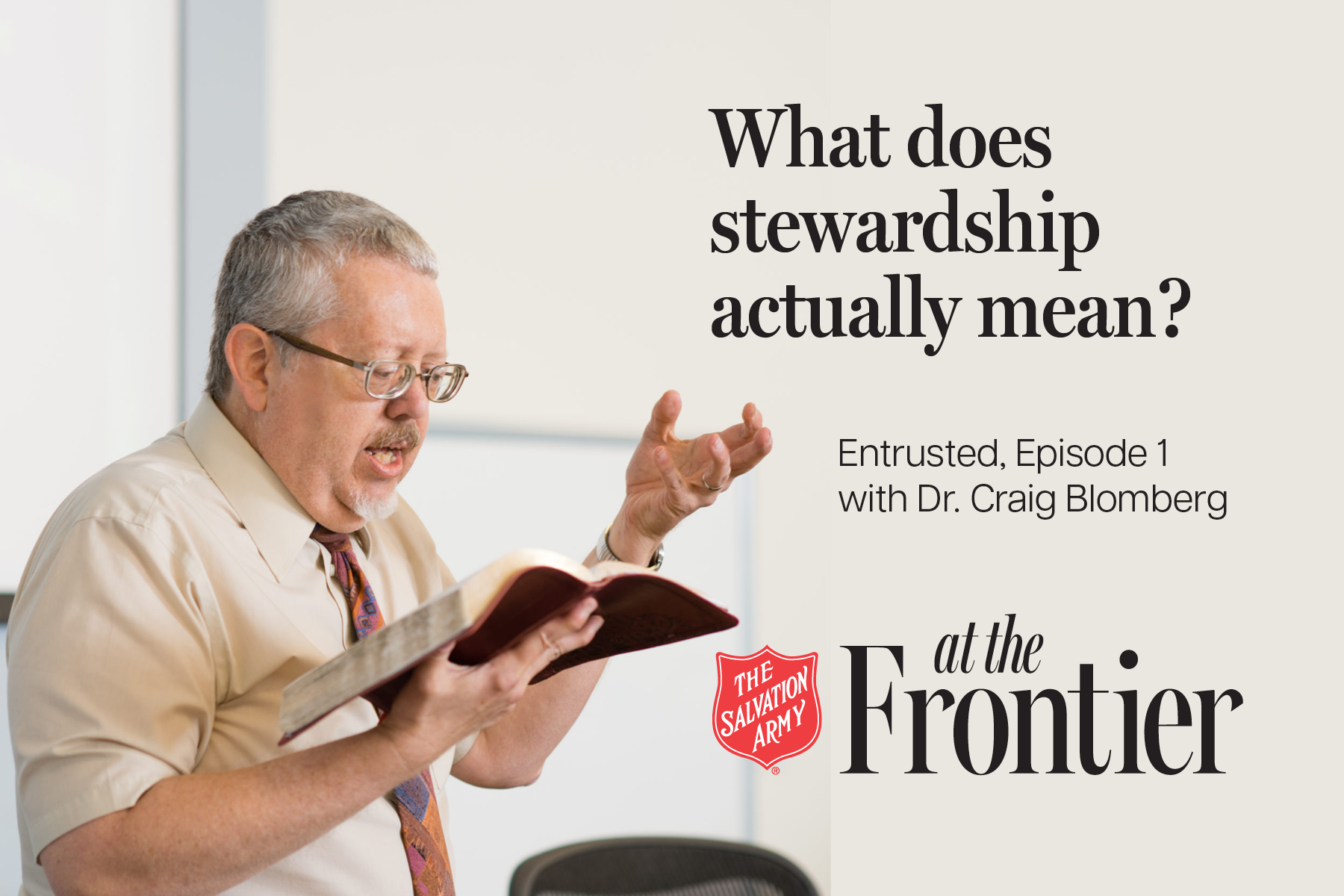
Entrusted, Episode 1 with Dr. Craig Blomberg
We often associate stewardship with money: Giving to the Church, managing our resources wisely or making the most of what we have. But what did the word mean to the people who first heard Jesus use it? And how far should we extend the idea today?
In the first episode of “Entrusted,” a six-part series from At the Frontier, host Christin Thieme speaks with Dr. Craig Blomberg, Professor Emeritus of New Testament at Denver Seminary and author of Neither Poverty nor Riches and Christians in an Age of Wealth.
Blomberg explains the biblical meaning of stewardship, why money and possessions figure so prominently in Jesus' teaching, and what the parable of the talents reveals about responsibility, accountability and risk. He also challenges a common assumption: While stewardship principles can inform how we use our time and abilities, broadening the concept shouldn't become a way to avoid what Scripture says about material possessions.
The conversation raises a question that will guide the series: If everything we have ultimately belongs to God, what does faithfulness require of us?
In this episode
-
What a steward actually was: The authority and responsibility of someone managing what belonged to another.
-
Why money matters: What Jesus' teachings reveal about possessions, generosity and accountability.
-
The danger of simply preserving what we've been given: What the parable of the talents suggests about putting resources to use and accepting thoughtful risk.
-
How far stewardship extends: Why Blomberg cautions against making the word mean everything.
-
What generosity looks like in practice: Why the percentage we give may tell only part of the story, and how Blomberg's own approach to giving has changed over time.
Listen to the episode
Listen and follow At the Frontier wherever you get your podcasts.
Episode transcript
The following transcript has been edited for clarity and readability.
Christin Thieme: When we hear the word stewardship, most of us probably think about money. Maybe a giving campaign. A sermon about tithing. A reminder to use what we have wisely.
But is that all stewardship means? And if it isn’t, how far does the idea actually reach?
What did stewardship mean to the people who first heard Jesus talk about it? What has God entrusted to us? And what does faithfulness require once something has been placed in our hands?
I'm Christin Thieme, and this is At the Frontier—a podcast from The Salvation Army exploring the questions shaping faith and mission.
We’re beginning a new series today called Entrusted.
Over the next several episodes, I’m asking what it means to faithfully care for what God has placed in our hands.
I came into this series wanting to talk about stewardship as something bigger than money. My first conversation challenged that assumption.
But before we can expand the idea, we need to understand what Scripture actually means by it—and whether there’s a danger in making stewardship mean everything.
Dr. Craig Blomberg is Professor Emeritus of New Testament at Denver Seminary, where he joined the faculty in 1986. He’s written extensively on Jesus’ parables, material possessions and biblical stewardship, including Neither Poverty nor Riches and Christians in an Age of Wealth.
So I asked Dr. Blomberg to help me start with a basic question: What is a steward, anyway?
Christin Thieme: Dr. Blomberg, thank you for being here and helping us start at the beginning of this conversation about stewardship.
Dr. Craig Blomberg: Thank you for having me.
Christin Thieme: When Christians use the word stewardship today, what do you think we generally mean by it and how close is that to what we actually find in Scripture?
Dr. Craig Blomberg: Great question. I think in part it depends on somebody's age. If you're older, I think the term still means how do you manage your money? Do you give to the Church? Do you give to Christian causes? I think younger generations sometimes take it more broadly, as what do I do with everything God has given me? But I'm sure there are plenty of exceptions to both of those trends.
Christin Thieme: I know you've spent much of your career studying the parables. So, when Jesus talked about a steward or a manager, what would his original listeners have understood that person to be?
Dr. Craig Blomberg: A steward, when the word is used that is not the common word for slave or servant, means somebody who is under the owner or master of an estate, but has been given, has been delegated the responsibility of overseeing that estate. And if there are other slaves or servants, then he would be roughly akin to what we might call a foreman today.
Christin Thieme: What kind of authority did a steward have over something that didn't actually belong to them?
Dr. Craig Blomberg: Pretty much whatever the master was willing to allow him to do, especially in the master's absence. There were a lot of absentee landlords in the ancient Near East. And we see those in the parables, somebody who goes away and the steward abuses his authority and starts beating up on miscreants and so forth. But it would always have been limited by whatever arrangements the master chose to make.
Christin Thieme: What made someone a faithful steward?
Dr. Craig Blomberg: Doing exactly no more, no less than what the master told them they should do.
Christin Thieme: When you look across scripture, what does God actually entrust to human beings?
Dr. Craig Blomberg: Everything that we like to think we have and own. I'm struck by Job after all of his losses when he says the Lord gives, the Lord takes away, blessed be the name of the Lord. And in the parable of the talents, everything that the master entrusts to his servants is what they are held accountable for.
Every now and then I will run into a Christian, either a speaker or writer, who says, "No, you owe God 10%. And once you've met that, you are free to do whatever you want with the rest." And I cringe when I hear that because first of all, I don't think in New Testament times it's a one size percentage fits all.
And secondly, we're never free to do anything we want with what God has given us because we can do some really bad things. We are always held to account. We will be held to a reckoning of all that God has entrusted us with.
Christin Thieme: So if we were to say everything belongs to God, we are simply stewards of it, is that a fair summary of the biblical picture, or is that too simplistic?
Dr. Craig Blomberg: No, I think that's a very fair summary.
Christin Thieme: If stewardship then is bigger than money, why do money and possessions show up so often when Jesus talks about faithfulness?
Dr. Craig Blomberg: Well, I don't know that we're ever given a comprehensive and direct answer to that question, but when we read texts like the love of money is a root of all kinds of evil, we can certainly guess. And personal experience certainly seems to confirm that how we spend our money is sometimes the very last area that a Christian begins to mature in, even when they have made progress in other areas.
I find it fascinating that 2 Corinthians, Paul spends the first seven chapters sounding much more hopeful and optimistic and praising the Corinthian church for the progress they've made. And if you are familiar with all of their problems that his first letter to them had to address, you go, "Wow, they've made really good progress."
But then the one area that he spends two entire chapters, 2 Corinthians 8 and 9 saying, "There's still one thing we got to talk about. You made some promises a year ago. The Christians just north of you up in Macedonia don't have nearly the resources you have, and they have been extraordinarily generous, so," of course I'm paraphrasing, "it's time to ante up, fulfill your pledge."
And I think that's true for a lot of people. My parents told me when I went off to college, there were two things I should never do. One was share my car and the other was talk about our family's money. And within a month, I think I violated both of those commandments, but I never told my folks.
Christin Thieme: Of course. Do you think living in an affluent culture makes it harder for us to recognize what we have as entrusted rather than owned, if you will?
Dr. Craig Blomberg: Yeah, absolutely. The people that chart American, but even there have been some studies in Europe of the amount of charitable giving, whether distinctively Christian or otherwise, the layer of society, if you split people into wealthy, upper middle class, lower middle class, poor, even just those four categories, the wealthy category percentage-wise consistently gives the smallest percentage of their earnings.
And of course, there are plenty of wonderful exceptions, but this is across the board. And yeah, I am sure that a lot of people think, "I have the ability and maybe even the responsibility to secure my own future. And so that's what I have to do above all."
Christin Thieme: Yeah. You mentioned the parable of the talents. This is one of the passages that we often associate with stewardship. What do we tend to misunderstand about that story?
Dr. Craig Blomberg: Oh, wow, how long do you have? No. Well, I mean, very basically the word talent means something quite different in modern day English, which is why recent translations have tried to do something like bags of gold or some rendering to make people realize that Jesus was talking about money, currency.
Now, do his principles apply to material possessions more broadly? Sure, they do. Can we then extrapolate further and say they apply to time, talents, as well as treasure, as we would use the term? Yeah, we can, but it's very easy to think, "Oh, well yeah, I'm active in my church and I am devoting my talents in the modern sense of the word to the Lord's work. So don't get on my case about how much I put in the offering plate." I'll leave it at that, but there are other things we could add.
Christin Thieme: I think it's interesting, the servant, he buried what he'd been given. He didn't lose it. He didn't squander it. You could say he protected it. So what's the difference between faithfully stewarding something and simply preserving it?
Dr. Craig Blomberg: Right. Not using something that could be in the process of being used for other people's good and even for your own. The people that have studied the ancient economy suggest that inflation, as we would call it, was very low, maybe at times about 1% a year. And yet even with that, if the cost of living is even slightly increasing from year to year, something that is going completely unused loses value.
And in one sense, our economies are different. Every now and then, you hear about somebody who dies and they find a huge wad of cash under their mattress. But for the most part, we understand that if we are going to keep a certain amount of our wealth, it ought to be making some money and there are ways to do that. But in any economy, if there are resources that are simply going unused and there really is no realistic use for them in the future.
I unfortunately will never be at a weight level that I was when I was a young man. I just know that unless I'm dying and shrivel up. So there really is no point in me keeping certain clothes that come nowhere close to fitting me under the unrealistic hopes that one day I will fit into them again. I should give them to Goodwill or whatever the local option is so that somebody who is the right size can use them.
Christin Thieme: Yes. Do you think faithful stewardship can require risk?
Dr. Craig Blomberg: Oh, absolutely. And I'm sure that's what the guy who buried his talent was thinking, "I could invest this in something. I could lose it. I could lose my shirt. And then what kind of trouble will I be in with the master?" And yet the master would've understood that, and he apparently doesn't allow that as a legitimate option.
Does that then mean that Christians should invest in every Ponzi scheme that comes along? Well, of course not. We are called to be shrewd, the parable of the unjust steward, which has all kinds of interesting questions attached to it, most of which can be solved when you just realize that the man was praised for his shrewdness, not for whatever nefarious stuff he had done.
Yes, we're called to be wise, but if we are going to not dig our equivalent of a hole in the ground and bury what we have, then there will be risk. There'll be risk that the seven boxes of theological books that I sent off three years ago to a friend in Rwanda and they are still sitting at the Kenyan border may never make it. And the more I look into that issue, the more I despair of there being a positive ending.
And I already know, as a matter of fact, that the books I sent to Donetsk Christian University back in the early 2010s were entirely burned up and used, as was the entire library, for fossil fuel by the Russian soldiers when they overran it. Those are risks I take, but I didn't know it was going to be that way. I probably wouldn't have offered them up if I had reason to think I would lose them. We still need to be shrewd.
Christin Thieme: Once we say that stewardship isn't just about money, there's a temptation to call almost everything stewardship, our time, relationships, bodies, opportunities, gifts, even the gospel itself. Can we make the idea so broad that it stops meaning anything? I mean, biblically, what makes something a matter of stewardship?
Dr. Craig Blomberg: That it deals with material possessions. That would be the simplest way of putting it. And on the one hand, I don't want to discourage the idea that people should think carefully and behave in a godly fashion as to how they use special abilities they've been given. But if that then becomes a substitute for, an excuse for not also and first of all applying things to our material possessions, then we've missed the boat.
I kind of chuckle each year when some of my friends for Lent like to practice fasting and are completely oblivious to the fact that fasting in Scripture meant going without food. It never meant going without anything else. And so they'll say, "Well, I fasted from social media." Well, that may or may not be a good thing, but that's not a fast. That's reapplying the word in a way it was never intended. So yeah, you can do the same thing with stewardship.
Christin Thieme: Right. If something really has been entrusted to me, then what does faithfulness require of me?
Dr. Craig Blomberg: That I use it in a way that would be honoring to and would please and further the objectives of the one who entrusted it to me.
Christin Thieme: Where does generosity fit? Is generosity the same thing as stewardship or is it an expression of it?
Dr. Craig Blomberg: Yeah, I would think it would be an expression. I can say that yes, part of my stewardship of my finances is, pick a figure, giving a hundred dollars every month to my church. And if I am making $10,000 a year, then that's $1,200. That's more than 10%. That is remarkably generous given that no one can really live on that little typically in our affluent subcultures today. But if I am making 100,000 a year and I'm giving 1,200 to my church, that's barely over 1%, and that can hardly qualify as being generous.
I think people understand the concept of generosity. The Bible never quantifies it and never attach a percentage to it, but it is above and beyond the expectations of a given society or a given subculture. Scripture even talks about sacrificial giving, and a sacrifice means doing something that requires you to give up a very valuable or cherished commodity of some kind. So if I'm going to give sacrificially and really was counting on getting that new roof this year that insurance won't pay for, but there are more pressing needs, okay, now I've made a little bit of a sacrifice.
Christin Thieme: I know you've studied and written about this for decades. Has your understanding of stewardship changed the way you personally live?
Dr. Craig Blomberg: Oh, absolutely. Not long after my wife and I were married, which now just over 47 years ago, there was a bestselling book that subsequently went through five editions by a well-known man who's now with the Lord named Ron Sider. For many years, he was part of a group called Evangelicals for Social Action. The book was entitled Rich Christians in an Age of Hunger, and based on 2 Corinthians 8:13-15, he unpacked the concept of a graduated tithe. Not that a tithe went to college and finished, but graduated in the sense of the more income you make, the higher a percentage it typically requires if what you give is going to qualify as in any way generous. Some people have phrased it, it's not how much you give, it's how much you have left.
And so he, Sider, challenged my wife and me to consider a model where if you've never tithed, 10% is great place to start. But as your income growth exceeds whatever cost of living growth might be going on, then consider increasing the percentage of your giving. And we did that, and starting out as a brand new teacher and in most educational contexts, the longer you teach and if you do a good job, your income grows a little bit, we would add a percentage point or sometimes two to our giving over the years. And barely even perceptible, especially when you give off the top as they say, and then learn how to live on the rest of your income and avoid credit card debt and things of that nature.
Christin Thieme: I'm ending every conversation in this series with the same question, and I'm interested to hear how different people will answer it. So Dr. Blomberg, I will start with you. What has God entrusted to you right now?
Dr. Craig Blomberg: In keeping with our conversation, I could start with a lot of things that aren't money, but I will start with money. My mother's father was a German immigrant to Iowa who worked as a small town family grocer, but invested money in a corporation founded by one of his friends in Muscatine, Iowa, and did all the wrong things according to investors counsel in basically not diversifying his funds, but just trying to support this one undertaking.
And when he died in 1984, at the age of 84, even his wife, my grandma, was stunned by the amount of money that he had made. He was a generous giver to his church and to charities, but very frugal in what he spent on himself and on his family. And in the 1980s, we like to joke for listeners who can remember the Reagan era, President Reagan talked about trickle-down economics from the wealthy. Well, we revised that definition and said, "No, it trickles down from my grandfather to then my grandmother, and then when she passed away to my mother, and then finally to my brother and me." And so we do have actual money that we are trying to be very good stewards of. And apart from that scenario, we'd be having different kinds of conversations about our budget.
But certainly as someone who on paper is retired, I'm never quite sure what to say when somebody says, "Well, you know there's no retirement in the Bible." I feel like saying, "Yeah, and there's no basketball either." It hadn't been invented. Nobody had invented retirement. You worked until you couldn't anymore. I don't think it's good stewardship of our physical bodies to work our jobs just flat out with no reduction of anything until we drop, because normally then we drop a lot sooner than we would otherwise.
But oh my goodness, whether it's online mail or snail mail, I am being bombarded weekly, if not daily, with the retirement community I should move to, with the cruises I should take, with the golf courses I should live next to. I don't even play golf. With the steak dinners I can get free if I'll listen to a two-hour spiel on what to do with my money and very much aware of what the world thinks I should be doing, not one of which is remotely close to any biblical teaching.
So in that sense, I do still work part-time. I travel to the extent that I can, and podcasts are wonderful. I can do it from my recliner while my hip replacement is still requiring some recovery. And I don't want to just move to Florida and find a golf course where I can watch the alligators threaten the golfers or whatever somebody else thinks my ideal should be.
Christin Thieme: Exactly. Well, thank you so much, Dr. Blomberg. It was lovely chatting with you.
Dr. Craig Blomberg: You are very welcome.
This episode is part of the “Entrusted” series from At the Frontier. Explore all six episodes examining what it means to faithfully care for what God has entrusted to us. Listen to the series.
Links and resources
-
Dr. Craig Blomberg: Professor Emeritus of New Testament, Denver Seminary.
-
Further reading: Neither Poverty nor Riches: A Biblical Theology of Material Possessions and Christians in an Age of Wealth, by Craig Blomberg.
-
Scripture discussed: Matthew 25:14–30 (the parable of the talents); Luke 16:1–13 (the dishonest manager); 2 Corinthians 8–9 (generosity and giving).
-
Related reading: Rich Christians in an Age of Hunger, by Ronald J. Sider, a book Blomberg credits with influencing his family's approach to giving.
Keep exploring
STAY CONNECTED. Subscribe to The New Frontier email newsletter for stories, ideas and conversations shaping The Salvation Army's mission.
FOLLOW ALONG. Find The New Frontier on Instagram for more from the people and communities we cover.
SUPPORT THE MISSION. Give to The Salvation Army.