Weekly Devotional: March 11, 2026
Share Story
Date
Author
Major Rick Raymer
GOD’S WORD
Matthew 21:10-17
Beginning March 4th, we will trace the final week of Jesus’ life, leading up to our celebration of the fact that Jesus is Risen! He is Risen, indeed!
MARCH 4 RIDING A DONKEY
MARCH 11 CLEARING TEMPLES
MARCH 18 WASHING FEET
MARCH 25 BREAKING HIS HEART
APRIL 1 RESURRECTION AWAKENING
The Lenten Series for this year will be excerpts from the late Commissioner Phil Needham’s book
"Lenten Awakening”
Daily Meditations From Ash Wednesday To Easter
Introduction to this week’s Devotional
“Walking The Last Week With Jesus”
We have arrived at the most significant week of Jesus’ life: his last on earth. I invite you to be present with Jesus on that final stage of his journey, to observe closely what he says and does. He still has so much to teach us about himself and our calling to live as his disciples. And there is so much to grasp—and to gain—as we move toward the week’s climax and try to take in the enormity of Jesus’ suffering and the universal benefit of his crucifixion.
I have mentioned before that as I write these pages, the world is suffering from the coronavirus pandemic. People around the world are getting sick and hundreds of thousands are dying. People are scared. We are fighting an enemy hidden from the naked eye. The best preventive for us all is isolation, but most of us are not used to such extended confinements. We become distracted and bored, fearful, even paranoid.
Considerating the last week of his life, what does Jesus offer us in the times of our uncertainty and even despair? He is facing his own enemies, and he knows this week will end with his own horrible death. Watching him this last week of his earthly life, we will see courage, humility, compassion, authenticity, and hope. He offers us, his disciples, these same gifts:
- Courage to act when fairness and judgment demand it
- Humility before God and each other
- Compassion for all who suffer and lose loved ones
- Authenticity as his followers, even if it calls us to suffer, and
- Sure hope in our future with Christ, come what may.
PERSONAL PRAYER
Dear Jesus of the human road, as we walk with you this final week of
your earthly life, open our eyes to see, our ears to hear, our minds
to grasp, and our hearts to be grasped by your every act of
compassion and by the saving scope of your
suffering and death. We ask this in Your
name, our worthy Savior and Lord.
Amen.
DEVOTIONAL
CLEARING TEMPLES
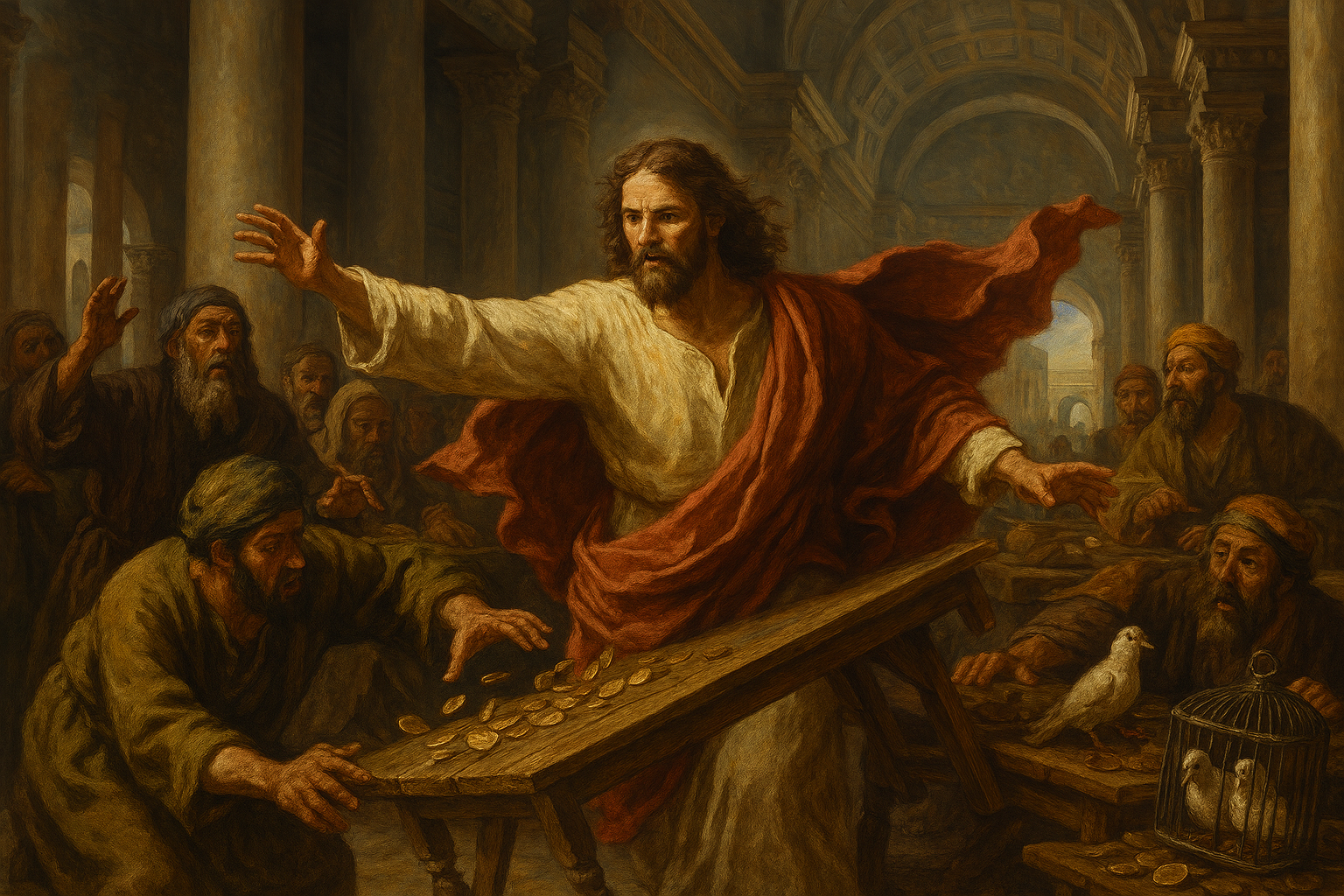
This last Monday of Jesus’ earthly life began in the Jewish place of worship. The week began with a peaceful parade into Jerusalem, Jesus riding on the humblest beast of burden, signaling a non-violent kingdom. Today, we see another side of Jesus, a stormy side, a coercive impulse. This is no “gentle Jesus, meek and mild.” This is Jesus, brimming with anger. What is the source of His explosive outburst? Has someone questioned His character, insulted Him, tried to make Him a laughingstock? Have His feelings been hurt, His ego undermined? Hardly. He’s been living with the demeaning attacks for three tumultuous years. Jesus is provoked by something quite different: worship. The Jesus we meet in the Gospels is a worshiper. Wherever He was on the Sabbath, He worshiped in the synagogue, or when in Jerusalem, the temple.
Sometimes He was asked to read from the Hebrew Bible and make comments. Once, He criticized certain Pharisees and Jewish theologians for their empty worship and shallow teaching (Mt. 15:9). You see, He was concerned about the worship of something or someone that was not God. During His wilderness temptation, He Himself had to overcome the temptation to worship Satan for the material and political gain it would bring Him (Luke 4:1-13).
In that day, worship was strongly identified with particular places considered sacred. In John’s account of Jesus’ encounter with the Samaritan woman, the woman raised the question of whether Mount Gerizim or Jerusalem was the proper center of worship. Jesus changed her question of where we worship to the question of how we worship. True worshipers will worship God, he said, “in spirit and truth” (John 4:24b). He foresaw that in His new Kingdom, any place could become holy, not by ecclesiastical designation, but by what happened there when God’s people humbled themselves before Him. Jesus probably sensed that the temple in Jerusalem would not last. Rome would have had enough of Jewish resistance on the border of their empire and would destroy both city and temple later that century.
Why, then, does Jesus cause a ruckus in the temple on this Monday of the last week of His life? The prophets whom He quotes while He attacks give us a good idea. First, there is Isaiah’s vision of the temple as “a house of prayer for all people,” including despised immigrants and eunuchs (Isaiah 56:3-8)! Then there is Jeremiah’s denunciation of those who use the temple as a cover for robbers (Jeremiah 7:11). Jesus quotes from both passages for good reason. The Court of the Gentiles is being used to exploit both poor Jewish and Gentile worshipers. Sacrificial animals are being sold to them at excessive mark-ups, and the sounds of barter are so deafening as to make worship impossible. Worship has been turned on its idolatrous head. Indeed, there is worship, but the objects are the gods of the powerful few, the gods who invite us to serve ourselves by exploiting others.
Jesus' actions seem impulsive. They are not. Mark tells us that Jesus did pay a brief visit to the temple later on the day before, the day of His triumphal entry, and then left "after He had looked around at everything" (Mark 11:11). He saw enough to disturb Him, enough to rouse His righteous indignation, enough to set Him at prayer that night at Bethany to bring Him to a decision to clear the temple in the morning. The next day, He sets out for the temple, whip of cords in hand, with the words of Psalm 69:9 ringing in His ears: "...passion for Your house has consumed Me, the insults of those who insult you have fallen on Me!"
The first thing He does when He enters the temple is to clear the premises of the self-servers and exploiters. For good measure, He pushes over the bartering tables. Matthew records that the next thing that happens is that those who need healing now feel free to emerge from the shadows, and Jesus releases them from their oppression. Children then start finding their way closer to Him, drawn to Him as they always are. They shout out the words they heard the day before, "Hosanna to the Son of David!"
This was the last straw for the chief priests and theologians, those who allowed and were presiding over the desecration of worship. Jesus, they say, "Do You hear what these children are saying?" Of course, He does. And He answers them, "From the lips of children and infants / you have ordained praise" (Psalm 8:2a, NIV). In place of the ugly sounds of aggressive commerce, the music of children announces the presence of the world-saving Messiah.
Very early in his ministry, according to John's Gospel, Jesus was consumed by a similar zeal for God's house and had acted similarly and cleared the temple. From the beginning to the end of his earthly ministry, Jesus attacks the denigration of worship.
Unfortunately, worship can be confiscated by other forces, repurposed for other ends.
How and why does that happen today? It happens when we go to worship to use our church connections for our own advantage.
It happens when we want to feel okay about our comfortable lives, so we seek a congregation that looks and acts like us and worships a god that affirms the way we are living, while saving us the discomfort of the words of judgment we really need.
It happens when we go to worship to escape our problems and gain enough "good feelings" to last us the coming week, without our having to deal with the actual issues in our lives and in the world around us.
It happens when we embrace a God who only "loves us just the way we are" and desires no more of us than He is getting.
It happens, in short, when our worship masks who and what we really are in our corrupted hearts and in our self-serving living.
Imagine yourself at church on a day when Jesus bursts into the chapel and drives out those we've just described: the all-too-comfortable and complacent, the exploiters of holy places and people, the seekers of an escape from the world God loves, the habitual sinners who confess their sins with no intention of changing, and the pious pretenders. Will you and I find ourselves still there in church after Jesus' clearing is over? And if not, what will we do?
PERSONAL PRAYER
Loving heavenly Father, I ask your forgiveness for the times I have come to
worship without worshiping, bringing with me only my wants and cravings.
Dear Lord Jesus, discipline me with shame for my pretense, my idolatrous
worship, and help me, as your disciple, to keep your example ever
before me. Blessed Holy Spirit, empower me to worship in spirit
and in truth, and then to live my whole week as a recognizable
extension of my worship, amen.