Unsung Heroes: 25 Years Later
By Warren L. Maye, Editor in Chief, SAconnects
"This young man said to me, 'This may seem very silly to you. It may seem like a silly request, but can we pray?' And after we'd finished, the young man stepped back and he said, 'Salvation.' He said, 'I've always known The Salvation Army as a charitable organization. I've always known that The Salvation Army does good things, but I never associated salvation with The Salvation Army. That's why you do what you do. I get it.'"
Ash filled the air. Heat from "The Pile" radiated through workers' steel-toed boots. Amid the chaos, dusty Salvation Army officers handed cups of coffee to weary first responders and simply stood beside them. No conversation, just compassion.
Twenty-five years later, people who served in the aftermath of 9/11 remember that their greatest contribution was not food, supplies, or logistics, although those were also important. It was their ministry of presence—caring for the whole person. These stories serve as a reminder that while tragedy may shatter the world, the instinct to serve and the capacity for compassion can still prevail.
Then & Now
When 'there' became 'here'
Bob Myers describes himself as an Emergency Disaster Services (EDS) professional, a role that has evolved since the attacks of September 11, 2001. He began as a volunteer with EDS in Pittsburgh and Shanksville, Pennsylvania, during the Flight 93 response. He was later hired in Philadelphia in early 2002, which allowed him to transition into a professional staff role and participate in the recovery efforts in New York.
Before that Tuesday in September, for Myers, "terrorism" was a concept relegated to evening news stories from far-flung corners of the globe. "It wasn't really happening here," he remembers. That sense of innocence would evaporate when the planes hit.
In an instant, the distance between "there" and "here" vanished, replaced by the smoke of the Pentagon; the crater in Shanksville where Flight 93 went down; and the smoldering ruins of the World Trade Center.
Over the days and weeks and months after the attacks, it slowly sank in that so many of the people who were missing would never be recovered for their families.
"I think for some of our folks who were serving at ground zero, that became a difficult burden to carry," says Myers.
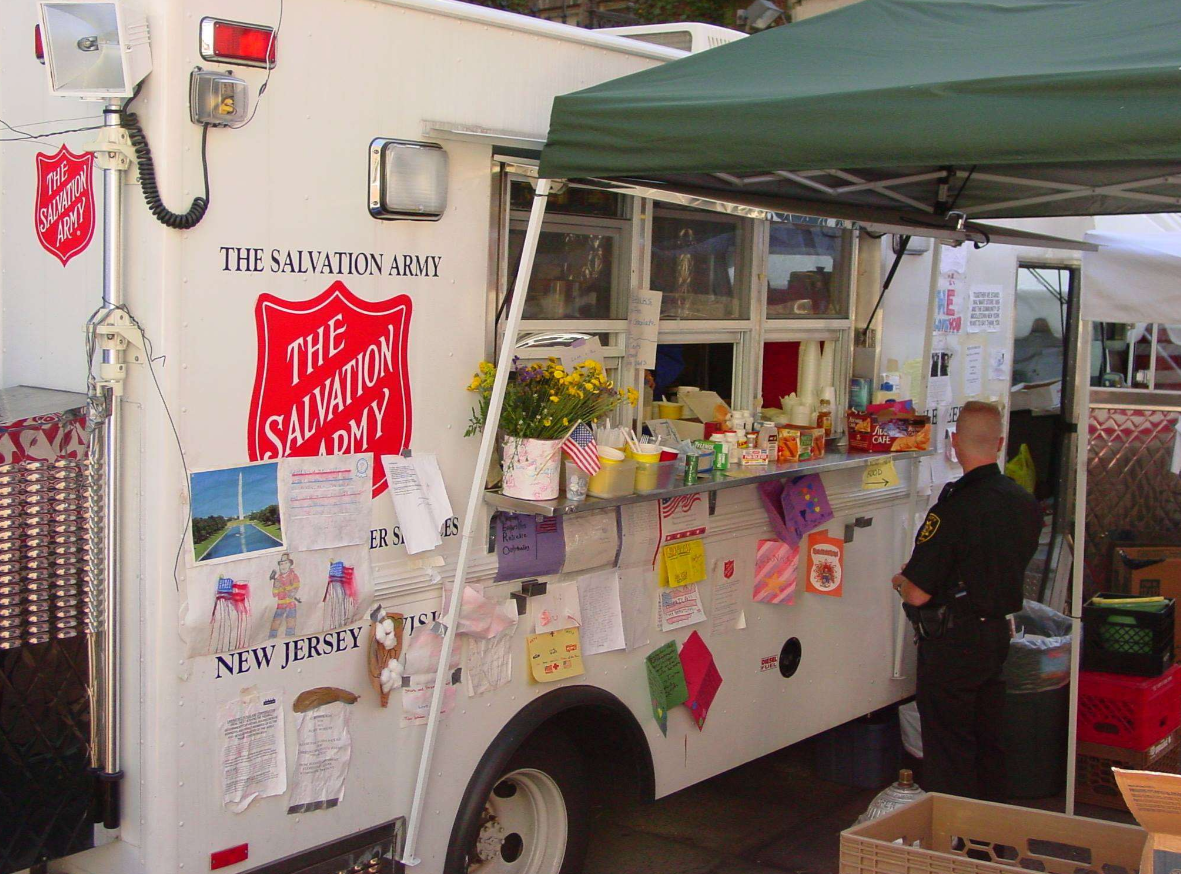
Indeed, the canteen ministry of The Salvation Army, once a simple provider of coffee and comfort, was thrust into the role of a professional emergency management force, born from the ashes of a world that had fundamentally changed.
"It was one of those things like, 'Oh, that happens in third-world countries or other parts of the world. It doesn't really happen here.'"
Whole-Person Care
What the uniform represents
In the middle of the disaster zone, then-Captain James Betts had to track down Salvation Army–owned John Deere Gator utility vehicles by their VIN numbers because the police had commandeered them. He hunted them down, street by street, to reclaim them for the Army's relief efforts.
Betts, then the Divisional Youth and Candidates Secretary in Northeast Ohio, arrived at ground zero feeling like an imposter, an officer without a manual trying to manage an unprecedented disaster. But he soon realized that he did not need to be an expert; he just needed to be there.
He recalls the moment when a stranger told him that his presence brought peace. In the face of incomprehensible grief, he learned that the Salvation Army uniform and the human connection it represented were more powerful than any logistical plan.
In our darkest moments, the most profound thing we can offer is simply our presence. Betts reminds us that even in a polarized world, there are sacred moments where we can see through the dust, hear above the din, and connect to one another as human beings.
"The presence of that uniform, your presence here, regardless of what you're saying or doing, your presence brings us peace. Your presence says to us, 'It's going to be okay.'"
Offering quiet comforts and compassion
Working in the grim reality of the morgue and around the debris pile, Major Molly Shotzberger found herself singing "Jingle Bells" and handing out water and bubble gum to exhausted first responders and recovery workers.
Thrust into a leadership role as a Pastoral Care Officer, Shotzberger organized teams for the morgue and Fresh Kills, a landfill that became a sorting ground for human remains among the rubble. Her experience is defined by the search for normalcy in an abnormal world. She did not just manage logistics; she managed the human spirit.
Shotzberger recalls speaking with a police officer at the morgue who'd survived a building collapse. He described the sensation of being buried alive as if a bag of sand had been tied over his head. It was a stark reminder of the fragility of life. To survive the stress, Shotzberger relied on small, human rituals: singing to herself, sharing gum and red licorice candy, and thoughtfully offering simple tokens of care to her teams—even literally washing their sore, soiled feet.
While military troops responded to the attacks in the Middle East, Shotzberger and those who served alongside her were warriors of compassion. The Compassion Under Fire Combat Ribbon she wears today is not just a badge. Conceived by then–Divisional Commander Colonel William LaMarr, with its yellow, red, and blue stripes, it is a symbol of the approximately 65 officers who stood on the front lines, forever bound by the darkest of moments. Shotzberger reminds us that even in the face of death, small tokens of care can relieve feelings of hopelessness and despair.
"In the chaos, I found my true calling in the ministry of presence."
Legacy in Action
Lessons in readiness
Even 25 years later, Major Marcus Jugenheimer cannot bring himself to eat a boiled hot dog. It's a reminder of the meager rations that sustained him and many others during the early days at ground zero.
Then-Captain Jugenheimer, alongside fellow officers Captain Brian Peabody and Captain Mark Unruh, arrived in Lower Manhattan by 2 p.m. on the day of the attacks. He felt sensory overload from the thick gray ash and the heat of the pit. It became a grueling cycle of 11-hour shifts and sleeping in cars.
They found an abandoned canteen truck, stripped of supplies and personnel—a blank slate for a desperate mission. With a ragtag group of volunteers—an attorney, a homeless man, and a college student—they began the work. They scoured local restaurants for food donations, bringing them back to ground zero to feed the responders.
Together they developed strategies to acquire resources and scale up operations, which have helped inform today's crisis response teams. Jugenheimer recruited and managed volunteers and supplies, while Peabody liaised with city agencies like the FDNY, the Office of Emergency Management, and the health department.
On the first anniversary of 9/11, a dreadful windstorm kicked up the dust, Jugenheimer remembers. It was a physical and emotional beating for the families gathered there. Yet, looking back, Jugenheimer's takeaway is clear: The aftermath was a testament to resilience in the face of an unnatural, devastating tragedy. The outpouring of love and support for a city that he considers home defined the American spirit.
He is a witness who saw both the worst and the best of humanity. He carries emotional and physical scars from those days, from the simple inability to eat a hot dog to several respiratory conditions. But Jugenheimer, Peabody, and Unruh represent the lifelong bonds that can be created among people who together survive great trauma.
"The Salvation Army, alongside other organizations, became a pillar of resilience."
Among the Unsung
The man on the street
Lt. Colonel Abraham Johnson was in a mundane finance meeting at Greater New York Divisional Headquarters when the news broke. Immediately, the headquarters on West 14th Street became the center of a massive, monthslong logistical operation involving the coordination of endless truckloads of supplies.
Johnson's world, like that of so many others, was shattered.
"People were dazed, crying, searching for their coworkers. Some were in shock," he remembers.
His work changed from pushing paper across his desk to managing the flood of supplies pouring into the building. Indeed, he was the man on the street, directing traffic and coordinating the influx of goods.
Johnson and his wife, the late Lt. Colonel Louise Johnson, both received the Army's highest honor, the Order of the Founder. Twenty-five years later, images of those trucks arriving, filled with contributions from individuals, churches, and other organizations, remain etched in his mind.
"The Army's reputation for meeting needs during hard times was what allowed us to fulfill our calling when the country needed us the most."
Providing long-term support
In 2001, Sarita Rosamilia was a college student working part-time at a restaurant in the World Trade Center. She'd missed work to attend a Salvation Army music camp, and the resulting two-week suspension kept her away on the morning of 9/11. As she watched the second plane hit the South Tower on television, she felt not shock, but terrifying numbness.
Instead of being a victim of circumstance, she became a healer. That evening, the Queens Temple Corps, where she worshiped, was overflowing. People who had never stepped foot in a church were there, desperate for hope. Sarita watched Corps Sergeant-Major Olga Pappageorge waiting for news of her son, James.
James, a firefighter who had graduated from the academy only weeks earlier, never came home. Another young woman from their church had called her mother to say a tearful goodbye before jumping from one of the towers. The tragedy was more than a news story; it was a wound in their own family.
The next day, Sarita and her father drove to ground zero to help however they could. As they approached, smoke rose in the distance. The destruction was absolute. She had worked there for a year, yet could not recognize the landscape. Overwhelmed, she could not bring herself to leave the vehicle and had to return to the corps.
Despite her horror, fear, and sorrow, Sarita became the Territorial Long-Term Recovery and Partnerships Coordinator for EDS. She helps support survivors who are walking through many of the same challenges that she experienced after 9/11. She turned the trauma into a lifelong commitment to ensuring that the next generation understands that healing takes time; that recovery is about far more than structures, but about the complex emotional and spiritual care of people.
"I have seen disasters from both sides—first as someone impacted, and now as someone called to serve."
A servant of the mission
Commissioner Joe Noland was Commander of the USA Eastern Territory when the planes hit. Always innovative, he operated on the principle that "chaos is an incubator for creativity." When the attacks occurred, he bypassed traditional committees, permission slips, and requisition processes to get supplies like Vicks VapoRub to responders within an hour.
Before 9/11, Noland's vision for the territory was centered on the theme "No Limits Together."
"Fortunately, we were able to transfer the concept of the vision into our response to 9/11," he says. "No limits. Just do it."
His team responded immediately, instinctually. Noland led the efforts like a servant who understands that salvation is a passion, not a profession. He refused to let organizational bureaucracy hinder the mission to provide aid and comfort to first responders and recovery workers. He realized that if they served with compassion, with a strong spiritual core, everything else—the funding, the support, the recognition—would follow.
Today, Noland's message remains a challenge to the next generation: "Do not change a thing; keep compassion as the motivating force."
"The impact of the Army's presence went beyond food and supplies. It was about the mission."
Presence Over Publicity
Heartfelt communication
Armed soldiers and FBI agents stopped Major A. Kenneth Wilson, a journalist for The War Cry magazine at National Headquarters, who was trying to document The Salvation Army's relief efforts. They seized his camera, opened it, and exposed his film to the light, destroying his work. They said he was in the middle of a restricted crime scene at the Pentagon.
Wilson had watched the world change on a small television before he saw the destruction at the Pentagon in person. He also witnessed the reality of the morgue at Bellevue Hospital in New York City, where the air smelled of death and the walls were covered in photos of the missing.
Despite the friction between the mission and governmental bureaucracy, Wilson saw The Salvation Army mobilized to document the response, producing millions of special-edition copies of Good News and The War Cry magazines to share the story of the Army's comprehensive relief effort.
He found that the most powerful tool in the chaos was the simple question, "What do you need?" The Salvation Army didn't just talk about "Doing the Most Good." They did it. His experience taught him that heartfelt communication and getting things done leads to public trust.
"The events of that day proved that The Salvation Army's actions spoke far louder than their words."
Accountability and availability
For Commissioner Ralph Bukiewicz, then a Michigan area commander and corps officer, the news of the towers' falling triggered a visceral need to serve in whatever capacity he could. He deployed to ground zero as a Public Information Officer. The reality was far beyond the two-dimensional images he had seen on the news. The air was thick with an acrid odor from the smoldering heap that would burn for weeks.
"There was no manual, no training session that could have prepared any of us for the magnitude of this response," he says. "Yet at the same time, The Salvation Army is extremely resourceful."
He was surrounded by people who were able to adjust daily and compensate for the challenges they faced. The need was so great that The Salvation Army supplied a workforce from all four USA territories and Canada.
Bukiewicz focused on accountability. He was there to tell the story of the service, and to provide a bridge between the donors, the people praying around the country and around the world, and the situation on the ground.
His days began at 7 a.m. with prayer in the basement of the Centennial Memorial Temple, followed by a drive into the red zone. Along the West Side Highway, residents lined the streets, waving flags and cheering for the responders. It was a humbling reminder of the expectation placed upon them.
Bukiewicz sought to connect the helpers with the helped. When he saw drawings from first graders in the Midwest taped to the walls for first responders to see, he made it his mission to call those schools. He wanted those children to hear the impact of their simple act of coloring. He saw Broadway actors show up on Mondays, their only day off, to feed the workers, setting aside their fame to help fellow Americans.
He recalls entering the American Express building, which had been vacated in a rush. Its broken windows and soot-covered sofas seemed frozen in time. "There was an outbox with a couple of FedEx packages marked 'urgent.' Things were scattered on the desk, and everything was covered in this huge layer of dust. I imagined, in that moment, everybody just ran."
Armed with a three-megapixel digital camera, Bukiewicz captured moments that were otherwise forbidden to the public. National Guardsmen with rifles sometimes tried to stop him, but Bukiewicz had a special dispensation from the fire chief and the mayor's office.
"I was surrounded by people who had poise, who had purpose, who had this inner strength that not only we could share with each other, but that we could draw from," he says. "There were moments that we couldn't quite shape into words what we were feeling."
But they could pray together, and sing together, even.
"God's presence was so obvious and so powerful," he says.
Looking back, Bukiewicz describes the experience as a lesson in availability: When we are available, God works through us. It was, as he calls it, his boot camp, preparing him for the life of service that would eventually lead him to become the Commander of the USA Eastern Territory.
"It was in some of those selfless acts of service that I recognized that even the word 'hero' was being redefined. They were everyday people, everyday Salvationists."
Were You There?
To the hundreds, if not thousands, of officers, soldiers, and volunteers who stood alongside The Salvation Army in the days, weeks, months, and years that followed: We cannot name you all, but we have not forgotten you. Your hands, your presence, and your service are woven into this story. If you were there and have a story to tell, we want to hear it.