Mercy With Buttons
By Kyle Hetrick /
One day before work, I went to the recovery meeting that has become my home many weekday mornings. It’s not a fancy place, but that is part of its beauty.
We meet outside, under the shade, protected from the morning sun. The chairs are simple and the coffee is ordinary; the people are anything but. It’s one of those places where the grace of God often shows itself with rugged honesty. Tired eyes. Candid stories. Laughter lighting up faces that know more pain than they let on. People learning one morning at a time how to stay alive, stay sober, and stay near enough to truth that it can still save them.
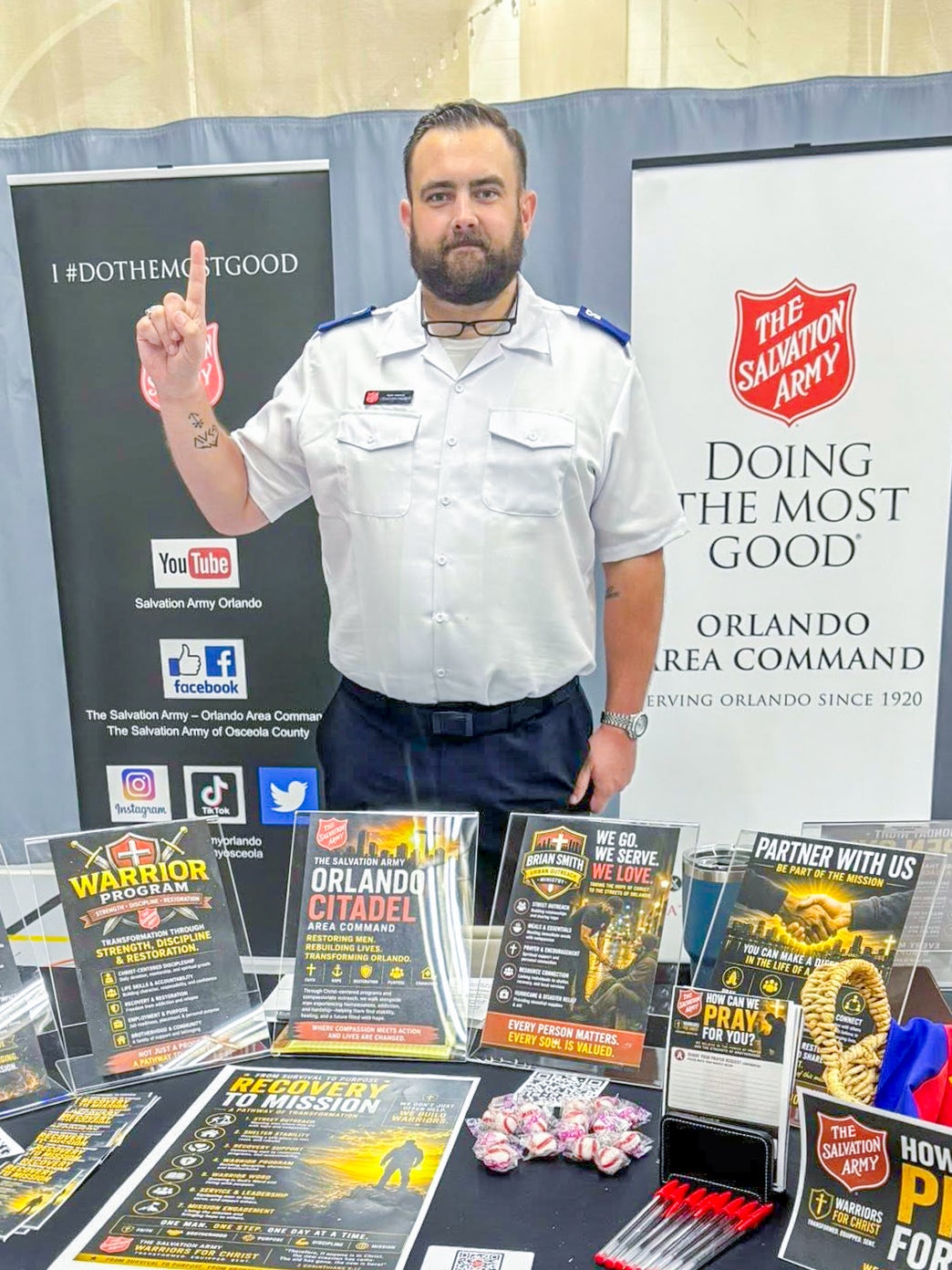
I was in uniform — not in my tunic, just a crisp new patriot shirt, open at the neck with no need for a tie, blue “S” epaulettes on my shoulders, neatly ironed slacks, black socks, and black shoes. I was ready for a full day of ministry at the corps capped off with Warrior Word, our men’s Bible study that evening.
I have worn many shirts in my life: team shirts, work shirts, fraternity letters, dress shirts for interviews. Shirts I was proud of. Shirts I probably should have thrown away. Shirts that marked a season, a role, a group, or an attempt to become someone I was not yet ready to be.
But this shirt is different. It may look like a uniform shirt, but, to me, it feels like mercy with buttons.
I do not mean that in a dramatic way; I mean it in the most practical way possible. When I put on that uniform, I remember that I am not my own rescue story. I am not the author of my second chance. I am not the hero of my recovery. I am a man who has been found, forgiven, restored, corrected, carried, and then somehow trusted to serve.
That is a terrifying and beautiful thing.
People sometimes mistake me for a pilot. I usually tell them I fly for Holy Spirit Airlines where the benefits are eternal, but the in-flight snacks are unpredictable.
The uniform sometimes opens a conversation about The Salvation Army. Other times it invites curiosity, confusion, or a joke. Sometimes it sparks a memory of a red kettle, a shelter, a Christmas gift, a meal, a disaster response truck, or someone’s grandmother who loved the Army long before they understood why.
But on this day, the question was different.
One of my friends arrived a little late to the meeting. After it ended, he came over to me. We had not spoken much recently except through prayer and devotion texts I send out daily. Life had been full: camp last week, vacation before that. Ordinary interruptions to the rhythms that keep friendships alive.
My friend looked at my uniform and asked, “Where can I get a shirt like that?”
It should have been an easy answer. I know exactly where to get the shirt. I know the website; I know where the pieces come from. But the shirt was not really the thing in question. At least, it was not the only question.
How do you explain that this is not merely a shirt? How do you explain that the blue epaulettes are not mere decoration? How do you explain the silver “S” without sounding like you belong to some secret society that meets behind a hidden door and distributes holy laundry to the worthy?
The truth is, the uniform is not something I wear because I am impressive; it is something I wear because I need reminding.
The “S” has long been understood in The Salvation Army as “Saved to Serve.” That little phrase carries more weight than is first apparent. It means salvation is not a trophy to be placed on a shelf. It is not a private religious achievement. It is not a spiritual certificate proving that I have figured out how to behave in public.
“Saved to Serve” means I have been given an assignment along with grace.
It means Christ did not pull me out of the wreckage so I could simply appreciate the fact that I survived. He saved me so that my life could become useful in His hands. He saved me so that my wounds could become windows instead of walls. He saved me so that the mercy I received would not stop with me.
The uniform says all of that before I even say a word. That is one of the reasons it matters to me so deeply. It is visible accountability. It tells the world I belong to Christ and that I am connected to an Army whose mission is to preach the gospel of Jesus Christ and meet human needs in His name without discrimination.
That last part matters: without discrimination. Not just serving people who look grateful enough. Not only serving people who know the right words to say. Not serving people once they are cleaned up, stable, housed, sober, polite, and easy to manage. Human needs. In His name. Without discrimination. I need a uniform that reminds me of that because my flesh is very good at creating exceptions.
The blue on my shoulders matters too. In The Salvation Army, blue epaulettes are worn by the soldiers – not officers, not commanders, not people who have somehow risen above ordinary discipleship – soldiers.
That word can be misunderstood if we let the world define it. A Salvation Army soldier is not someone called to conquer people. He is someone called to be conquered by Christ so completely that love becomes his discipline. It is not about rank over others. It is about surrender to Jesus. It is a public sign that I have made a covenant to live as a disciple, a witness, and a servant.
I have signed that covenant twice. That sentence carries more story than I can fit here. The first time, I meant it. The second time, I understood more deeply how much I needed grace to keep meaning it. My uniform carries both of those signatures. It carries the joy of belonging and the ache of failure. It carries the memory of promises made, promises broken, and promises restored by a Savior who does not throw away bruised reeds or smoldering wicks.
So when my friend asked where he could get a shirt like that, I did not simply tell him where to order one. I invited him to church.
“Yeah, I might do that!” he said.
And there it was. A question about a shirt became an open door to the house of God.
From there I could tell him a little more. I could explain what the “S” meant. I could explain the blue. I could explain that this was not about earning a uniform like a prize. It was about belonging to Christ, joining a covenant people, learning to serve, and letting the outward sign tell the truth about an inward surrender.
You do not earn a Salvation Army uniform the way a man earns a medal. You receive it as a sign of a covenant. And even that covenant is not a boast. It is not a claim that you have become strong enough for God. It is a confession that Christ is strong enough for you, and now your life is available for His purposes.
That is what I hope my friend sees — not me, not a crisp shirt, not black shoes and ironed slacks, not some polished religious version of the man who once made a mess of his own life. I hope he sees a signpost. That is all a uniform should ever be. A signpost. A visible witness pointing away from the person wearing it and toward the One who saves, sanctifies, restores, and sends.
I am grateful for the uniform because it gives people permission to ask questions they may not have asked otherwise. It creates little cracks in ordinary conversation where grace can slip through. It turns a parking lot into a chapel, a recovery meeting into a mission field, a shirt into a sermon, and a simple question into an invitation.
Where can I get a shirt like that?
Come and see.
Come to church.
Come meet the people.
Come hear the gospel.
Come learn what it all means.
Come discover that the real garment Christ gives is not cotton, polyester, or polished trim. It is mercy. It is righteousness. It is a new life. It is the strange and holy joy of being saved to serve.
And if one day my friend puts on that same uniform, I hope he discovers what I am still learning every time I put mine on:
It is not a costume.
It is not a status symbol.
It is not a secret club.
It is a witness.
It is a covenant.
It is a reminder.
It is mercy with buttons.
And every time I put it on, I am praying with my life: Lord Jesus, You saved me. Now make me useful.