Answering the Call to Emergency Disaster Services
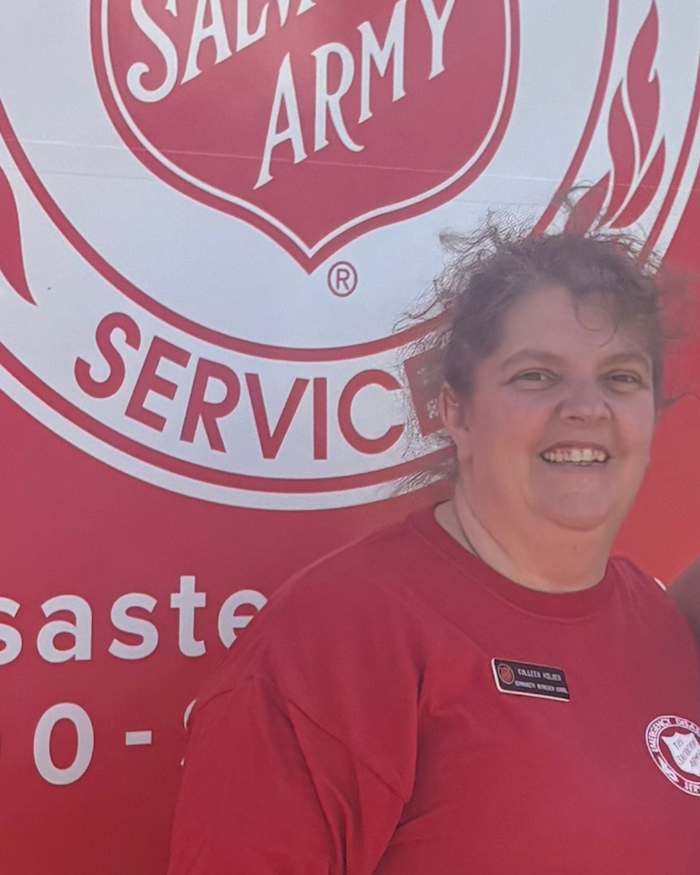
When Colleen Hilber first joined The Salvation Army 15 years ago, she stepped into her role as a volunteer coordinator at the busiest possible time. It was December 1, right in the heart of the Christmas season. Her days were filled with organizing bell ringers and keeping holiday efforts running smoothly. Disaster response was nowhere on her radar.
That changed just weeks later.
A call came in that grain bins were on fire, and firefighters were facing a long, grueling operation. Colleen was asked a simple question: Could she help?
What followed was a 10-hour night that would shape the next decade and a half of her life. Colleen and a coworker loaded up a canteen and headed to the scene with a willingness to listen and learn.
She remembers telling the firefighters, “We’re new at this. You tell us what you need and we’ll figure it out.”
That humility became her foundation. While others might have been overwhelmed, Colleen was energized. From that moment on, she leaned into Salvation Army Emergency Disaster Services (EDS) and gradually took ownership of that important role. But early challenges made it clear that trust had to be established.
“There were times we’d show up and no one would come to the canteen,” she explained. “I’m not sure why. Maybe it was based on past experiences, or they didn’t know how to utilize us. But that didn’t matter to me. I knew people could benefit from The Salvation Army and I wanted to help as many as I could.”
That’s when she decided to change her approach. Instead of quietly waiting in the wings, she stepped up and started conversations. She asked questions. She showed up, and not just at emergencies, but at meetings, training opportunities, and community events.
Colleen’s persistence paid off. Fire departments began inviting her to be a part of their conversations. Police departments helped integrate The Salvation Army into dispatch systems and provided pagers to streamline response. Over time, those professional relationships became deeply personal.
“Things just kept growing,” she said. “Now I’m part of their family, and they’re part of mine.”
That bond was evident when firefighters drove three hours to attend her mother’s funeral. It’s also reflected in the trust placed in her during emergencies. It’s trust that allows her to lead, adapt, and advocate for those in crisis.
Now serving as Community Outreach Director for The Salvation Army Wisconsin and Upper Michigan Division, Colleen continues to oversee disaster services, volunteer coordination, and community engagement. But her philosophy remains simple,
“I don’t ask a volunteer to do something I wouldn’t do.”
She emphasizes hands-on learning, often bringing new volunteers to training exercises before committing them to real deployments.
“Not everyone is meant for disaster work,” she said. “And that’s okay. It’s better to find that out early.”
Salvation Army EDS teams across the Central Territory are always looking for more volunteers. You are invited to be part of a credentialed group of individuals who provide basic human needs to survivors and first responders in the aftermath of a disaster. Are you up for the challenge?