Good Samaritan
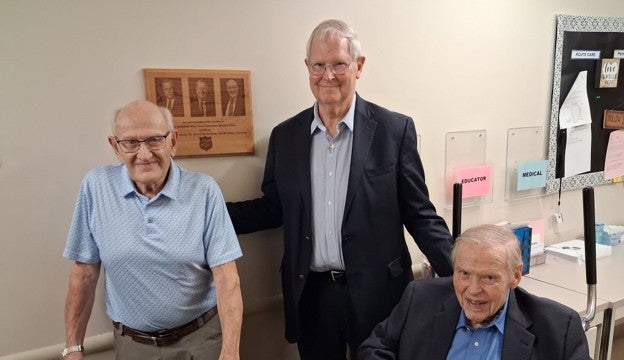
Thirty-one years ago, three Mayo Clinic physicians were all seeing an increase in the number of patients unable to obtain care because they did not have health insurance. Dr. Charles Kennedy, Dr. Jarrett Richardson, and Dr. Robert Stanhope all knew one another because they attended the same church, and they made the collective decision to do something about this need.
Concidentally, they also attended church with a member of The Salvation Army Advisory Board. When their first ask for a space to treat patients didn’t pan out, that board member connected them with The Salvation Army.
Initially, Dr. Kennedy, an internal medicine physician, provided care for the adult day program The Salvation Army operated at the time. “There was a nurse practitioner on staff, and every once in a while, she would call me if one of her day program clients needed to be seen by a physician. I was unofficially on call,” said Dr. Kennedy.
Then, the conversation with The Salvation Army turned toward offering a clinic after hours. The Corps Officer at the time, Major Morrison, had been transferred to Rochester, MN from La Crosse, WI, where he had tried and failed to establish a clinic like this. He jumped at the opportunity to try again in Rochester.
“People really came out of the woodwork,” said Dr. Kennedy, “Doctors, pharmacists, I just couldn’t believe how people showed up.” The clinic was called The Salvation Army Free Acute Care Clinic. It first opened its doors to patients in February 1995.
The earliest volunteers in the clinic used the second floor of The Salvation Army Corps Community Center building in downtown Rochester to provide one acute care clinic a week. Dr. Kennedy recounted the experience of providing “cowboy medicine.” Volunteers would use curtain dividers hung from the ceiling to create pseudo-exam rooms.
“In the very beginning, we couldn’t guarantee we would have the medications patients would need. Then, a local pharmacist who still lives here in Rochester told us that, if we had a patient who needed a medication that we didn’t have, that he would pay for that medication at his cost.”
Securing malpractice insurance was also critical to the establishment of the clinic. Dr. Stanhope served as the Chair of the Clinical Practice Committee at the time, a role that resulted in him having a seat with the board of governors of Mayo Clinic. He advocated for Mayo Clinic to extend the malpractice coverage of their physicians and staff to those same people when they provided care to patients at The Salvation Army.
“Without the insurance, this clinic would have never gotten off the ground,” Dr. Alan Wright, a retired infections disease specialist at Mayo Clinic.
What was first a walk-in acute care clinic has now grown to support between 3,500 and 4,000 patients in a year. It has also been renamed The Salvation Army Good Samaritan Health Clinic, lovingly referred to as the ‘Good Sam.’
As the clinic grew, so too did the support of Mayo Clinic. Now, in 2026, all first- year Mayo Clinic medical students provide volunteer care to patients at The Salvation Army as a part of their curriculum. Students learn about the social determinants of health, while also gaining real clinical experience and providing an additional two clinics a week for patients.
Mayo Clinic now also provides all pharmaceuticals distributed by The Salvation Army clinic as an in-kind donation. “If one of our patients needs a pharmaceutical, with the only exception being narcotics, we can get it for them without charge to that patient,” said Major Randy Hellstrom, Corps Officer of The Salvation Army in Rochester. “We’re talking about tens of thousands of dollars in donated medicine so that people don’t go without insulin or heart medications, among other things.”
And the specialty clinics offered within the medical clinic have grown to include acute care, pediatrics, ophthalmology, diabetes and hypertension, cardiology, neurology, rheumatology, dermatology, a breast clinic, pulmonology, and a physical medicine clinic that will begin providing services in September 2027.
“The doctors who have started this clinic have left an incredible legacy,” said Major Randy, “This clinic has now served more thousands of patients than the number of years it has been in operation. With that number being 31 years, it’s made an incredible impact.”
To honor founders of The Salvation Army Good Samaritan Medical Clinic, Salvation Army staff and volunteers collaborated to create a plaque depicting each of the three founders, and commemorating the founding of the clinic in 1995. “It was so special to be able to invite all three founders, and their families, back to the clinic they started over three decades ago,” said Major Randy. “It really was very moving to show them the beautiful space this clinic has become. It’s no longer curtains hung from the ceiling of a conference room, it’s a beautiful clinic that’s designed for exactly what it does. We all shed tears for how wonderful it is.”
The plaque now hangs in the medical clinic, where all patients, volunteers and staff see it as a part of their daily routine. It serves as a reminder of just how far the clinic has come, and how far it has the capacity to go.
The leadership, staff, and many volunteers of The Salvation Army would like to extend their sincerest thanks to Dr. Charles Kennedy, Dr. Jarrett Richardson, and Dr. Robert Stanhope.
To learn more about how you can support The Salvation Army Good Samaritan Health Clinic, please visit RochesterSA.org.